
Progress
Weight Loss Plateau on Ozempic or Zepbound — Why It Happens
Weight loss stalled on Ozempic, Wegovy or Zepbound? What the trials show about plateaus, why they happen, what to track instead, and when to talk to your prescriber.
For months the scale went one way. Then, sometime around the fifth or sixth month, it stopped. Three Mondays in a row, the same number, give or take a few tenths. You haven't changed anything, and you start to wonder whether the medication has quietly stopped working.
It's one of the most common worries on a GLP-1, and it's usually less alarming than it feels. Weight loss on these medications was never a straight line, even in the trials.
What does weight loss look like over time in the trials?
A curve that starts steep and gradually flattens. In STEP 1, the main trial of semaglutide 2.4 mg (the dose in Wegovy), people lost weight from the first check at week 4, and average weight loss reached its lowest point at week 60. By the end of the 68-week trial, the average change was −14.9%, against −2.4% on placebo.
SURMOUNT-1, the main trial of tirzepatide (Zepbound), ran for 72 weeks, including 20 weeks of dose steps. Average weight change at week 72 ranged from −15.0% to −20.9% depending on dose, against −3.1% on placebo.
| Trial | Medication | Length | Average change at the end | Placebo |
|---|---|---|---|---|
| STEP 1 | Semaglutide 2.4 mg | 68 weeks | −14.9% | −2.4% |
| SURMOUNT-1 | Tirzepatide 5–15 mg | 72 weeks | −15.0% to −20.9% | −3.1% |
These are averages from different trials with different people. They aren't a target, and they aren't a forecast for you. If you'd like a rough sense of your own pace, our weight loss timeline calculator can help frame the conversation.
When do individual people tend to plateau?
Earlier than the averages suggest, and at very different times. A 2025 analysis of tirzepatide trial data defined a plateau as less than 5% weight change over 12 weeks and every 12 weeks after. Looking at people who took their medication as planned and lost at least 5%, the typical (median) person in SURMOUNT-1 plateaued at about 24 weeks if they started with overweight, about 26 weeks with class I obesity, and about 36 weeks with class II or III obesity. Close to 9 in 10 had reached a plateau by week 72.
The authors make a point worth repeating: a plateau is easy to mistake for the medication losing its effect. They describe it instead as the body moving from losing weight to holding a new, lower weight, the start of what ideally becomes long-term maintenance. They also note there's no agreed definition of a plateau, and that these findings are exploratory.
Why does weight loss slow down?
Because your body pushes back as you lose weight. Researchers Kevin Hall and Scott Kahan estimate that for every kilogram lost, the calories your body burns each day fall by about 20–30, while appetite rises by about 100 calories a day. That second part, the appetite response, is the bigger driver.
A smaller body also simply needs less energy to run. Put together, the gap between what you eat and what you burn narrows until the two meet. A GLP-1 helps by quieting appetite, but the same biology still applies, which is why the curve bends.
Is it really a plateau, or just a noisy week?
Often it's the second. The tirzepatide analysis notes that day-to-day weight changes of about 1–2% are normal fluctuation. Salt, a late meal, constipation, hormones, a hard workout or a long flight can all show up on the scale for a few days.
That's why a single weigh-in tells you very little. A weekly average smooths out the noise. If the average is still drifting down, even slowly, you're not on a plateau. If it's been flat for several weeks, that's real information.
It's also worth looking past the scale. If you're strength training and eating enough protein, your clothes may fit differently while your weight barely moves. Our page on GLP-1 muscle loss explains why holding on to lean mass matters, and the 2025 joint nutrition advisory pairs GLP-1 treatment with regular resistance training and adequate protein.
When should I talk to my prescriber?
Any time a stall worries you, and especially if:
- Your weekly average has been flat for several weeks and you want to understand why.
- You're regaining weight steadily rather than holding.
- You're struggling to eat enough, or side effects make meals hard.
- You're thinking about stopping or changing your medication.
On that last point: in the STEP 1 extension, people who stopped semaglutide regained about two-thirds of the weight they had lost within a year. That's not a reason to stay on anything without question. It's a reason to make any change with your prescriber, not alone. Decisions about your dose belong in that conversation too.
What we'd track
- Weekly average weight. Weigh in the same way at the same time, then judge by the weekly average, not the daily number.
- Protein. It helps protect muscle, and on low-appetite days it's often the first thing to slip.
- Strength sessions. A heavier weight or a few more reps is progress the scale can't see.
- Waist or clothing fit. A tape measure once a month, or one pair of jeans, written in your notes.
- Dose days and side effects. A stall that lines up with a rough patch of nausea or fatigue tells a different story.
Holt shows your weight as a weekly average and as a chart over 7 days, 30 days, 90 days or a year, along with your percent to goal. Meal photos estimate protein, Apple Health brings in your workouts and weigh-ins, and side effects sit against your dose days on one timeline.
See your weekly average, not just today's number, in HoltBefore your next appointment, the Doctor Visit Report turns your trend, doses and side effects into one PDF with suggested questions to ask. For a wider look at measuring progress, see our GLP-1 progress tracker page.
See it in Holt
Real screens from the app — the same places you’ll log, review and share.
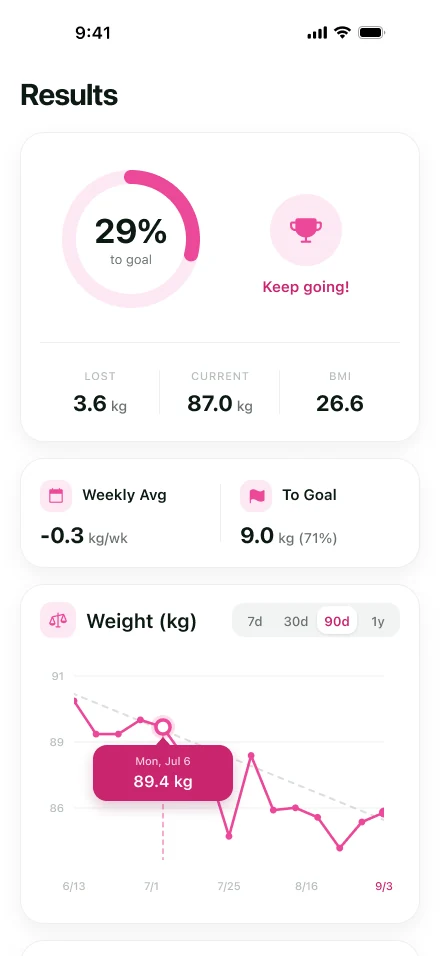
Progress toward your goal 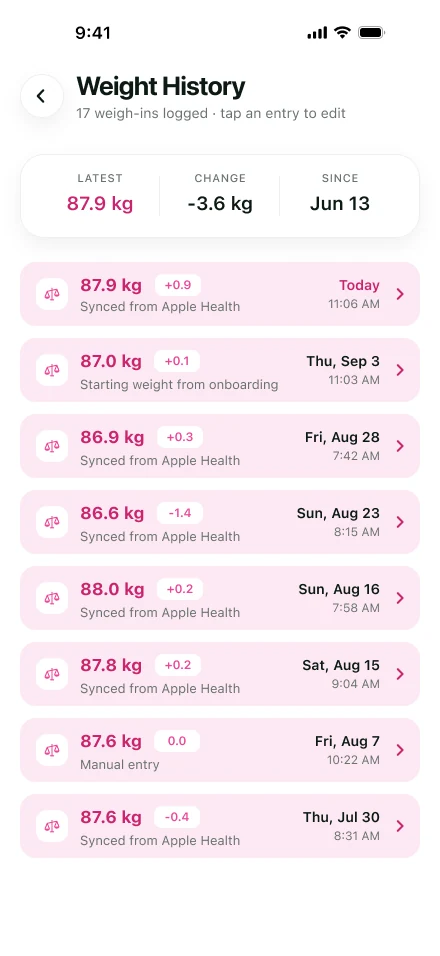
Weight history 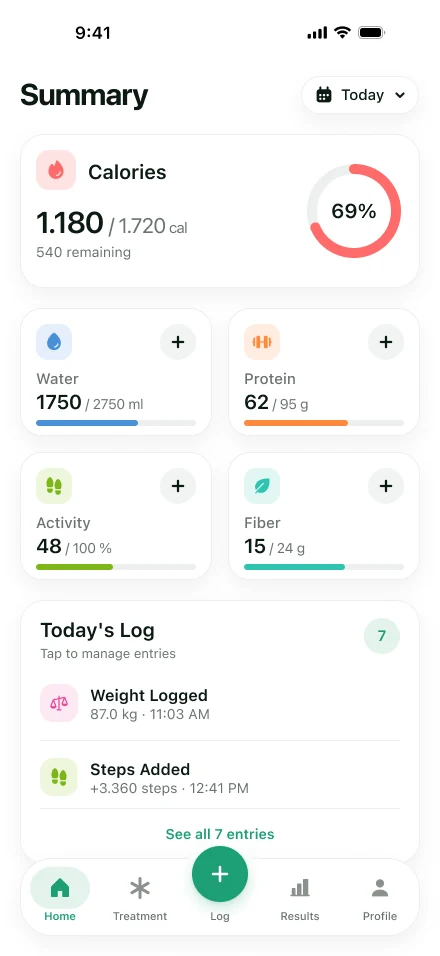
Your day at a glance
Frequently asked questions
When does weight loss usually plateau on a GLP-1?
It varies a lot from person to person. In the STEP 1 trial of semaglutide 2.4 mg, average weight loss reached its lowest point at week 60. In an analysis of tirzepatide trials, the typical person's weight loss slowed to a plateau somewhere between about 24 and 36 weeks, depending on starting BMI.
Does a plateau mean my medication has stopped working?
Not necessarily. A plateau is the point where the body reaches a new balance, and researchers note it's easy to mistake for the medication losing its effect. Whether your treatment plan should change is a decision for you and your prescriber.
How long should I wait before calling it a plateau?
There's no agreed definition. Day-to-day weight naturally moves by about 1–2%, so a few flat days mean little. A weekly average that hasn't moved for several weeks is a reasonable thing to bring to your prescriber.
What happens if I stop the medication because of a plateau?
In the STEP 1 extension, people who stopped semaglutide regained about two-thirds of the weight they had lost within a year. Talk to your prescriber before making any change to your treatment.
Sources
- Once-Weekly Semaglutide in Adults with Overweight or Obesity (STEP 1) — New England Journal of Medicine, 2021
- Tirzepatide Once Weekly for the Treatment of Obesity (SURMOUNT-1) — New England Journal of Medicine, 2022
- Time to weight plateau with tirzepatide treatment in the SURMOUNT-1 and SURMOUNT-4 clinical trials — Clinical Obesity, 2025
- Maintenance of lost weight and long-term management of obesity — Medical Clinics of North America, 2018
- Weight regain and cardiometabolic effects after withdrawal of semaglutide: The STEP 1 trial extension — Diabetes, Obesity and Metabolism, 2022
- Nutritional priorities to support GLP-1 therapy for obesity: a joint Advisory from the American College of Lifestyle Medicine, the American Society for Nutrition, the Obesity Medicine Association, and The Obesity Society — Obesity (Silver Spring), 2025
Keep reading
 Progress
Ozempic Face and Loose Skin After GLP-1 Weight Loss
"Ozempic face" is a media term, not a diagnosis. What research says about facial volume loss and loose skin after GLP-1 weight loss, and what is still unknown.
 Nutrition
Eating Out on Ozempic or Zepbound — How to Order and Enjoy It
Eating out on a GLP-1 with a smaller appetite? How to order protein-first, handle big portions and rich food, box leftovers, and log the meal without fuss.
 Lifestyle
Alcohol on Ozempic or Zepbound — What the Labels and Research Say
Can you drink on Ozempic, Wegovy or Zepbound? What the labels do and don't say, what early research shows about GLP-1s and alcohol cravings, and what to note.