
Orforglipron Side Effects — What the Trials Found by Dose
Orforglipron side effects from its 72-week trials — how rates rose with dose, what differed with type 2 diabetes, lab changes and drug interactions.
Worth remembering
- Stomach side effects were reported by 60% at 5.5 mg and 69% at 17.2 mg, versus 37% on placebo.
- Stopping because of side effects rose with dose, from 6% at 5.5 mg to 10% at 17.2 mg, versus 3% on placebo.
- In the diabetes trial, low blood sugar mostly occurred alongside a sulfonylurea.
- Pancreatic enzymes rose on average; the label says what that means clinically isn't known without other signs.
- Some medicines raise orforglipron levels sharply, which is why the label caps the dose at 9 mg with strong CYP3A4 inhibitors.
You've read that orforglipron is a new kind of GLP-1 — a small molecule rather than a peptide — and you're wondering whether that means a new kind of side-effect list too. Maybe you're deciding with your prescriber, or you've joined a study and want to know what the earlier trials saw. Here's what the evidence behind the label shows.
Where does the side-effect data come from?
The US label, sold as Foundayo, pools two 72-week, double-blind, placebo-controlled trials:
- Trial 1 (ATTAIN-1) — 3,127 adults with obesity or overweight and without diabetes, published in the New England Journal of Medicine.
- Trial 2 — 1,613 adults with overweight or obesity and type 2 diabetes.
In total, 3,155 people took orforglipron for up to 72 weeks. Doses were 5.5, 9 or 17.2 mg once daily, reached gradually from 0.8 mg.
How did side effects change with dose?
This is where the trials are most informative. Most stomach side effects climbed between 5.5 mg and the higher doses:
| Placebo | 5.5 mg | 9 mg | 17.2 mg | |
|---|---|---|---|---|
| Any stomach side effect | 37% | 60% | 68% | 69% |
| Nausea | 10% | 26% | 34% | 35% |
| Vomiting | 4% | 13% | 21% | 24% |
| Diarrhea | 11% | 21% | 23% | 25% |
| Constipation | 9% | 20% | 27% | 24% |
| Indigestion | 4% | 12% | 16% | 13% |
| Fatigue | 4% | 6% | 7% | 9% |
| Stopped because of side effects | 3% | 6% | 9% | 10% |
The label says most people who stopped did so because of stomach side effects, and that nausea, vomiting and diarrhea were most frequent during dose escalation and declined over time.
Was anything different with type 2 diabetes?
Low blood sugar is the main difference. In Trial 2, it was reported in 2% on orforglipron versus 0.2% on placebo, with one severe case. Most of the risk sat with sulfonylureas: 7% of people taking one had low blood sugar, versus 0.5% of those who weren't.
The label also lists diabetic eye disease as a precaution. Orforglipron wasn't studied in people needing urgent treatment for retinopathy, and anyone with a history of it should be monitored.
What showed up beyond the stomach?
Pooled across both trials, the label reports:
- Heart rate. A fast heart rate in 3% versus 0.9%; resting rate rose by 4 to 5 beats per minute on average.
- Low blood pressure. 2% versus 0.5%, and 4% in people also on blood pressure medicines.
- Hair loss. 4% to 5% versus 2%, linked to weight reduction and more common in women.
- Pancreatitis. Six confirmed cases on orforglipron, versus two events in one placebo patient.
- Gallstones. 1% versus 0.7%.
- Kidney injury. 0.2% versus 0.05%, the class's usual link to dehydration.
- Altered skin sensations (dysesthesia). Uncommon, at 0.3% to 1% on the higher doses.
Do lab tests change?
Yes, on average. Pancreatic amylase rose by 16% to 20% and lipase by 26% to 31%, versus 3% and 4% on placebo. The label says the clinical significance of these rises isn't known without other signs and symptoms of pancreatitis. Worth knowing if your blood work comes back flagged.
Can other medicines change side effects?
They can change how much orforglipron is in your blood. It's cleared mainly by the liver enzyme CYP3A4. In a study, the antibiotic clarithromycin raised orforglipron exposure about 3.5-fold, which is why the label caps the dose at 9 mg with strong CYP3A4 inhibitors. Orforglipron also roughly doubled simvastatin exposure, so the label limits simvastatin to 20 mg a day. Your prescriber and pharmacist need your full medicine list.
What we'd track
The trial data points to a few notes worth keeping:
- Your dose and the date of each step. Side effects rose with dose, so every symptom needs a dose next to it.
- A daily stomach rating. To see whether it settles within the step, as the label describes.
- New medicines, with start dates. CYP3A4 interactions can change your orforglipron levels.
- Blood sugar readings, if you have diabetes and take a sulfonylurea or insulin.
- Dizzy spells and a racing heart. Both showed up more often than on placebo.
Holt logs daily pills as well as weekly shots, with side-effect sliders lined up against your dose history, custom side effects for anything not on the list, and a doctor-visit report with suggested questions. It's free to download, with an optional subscription.
Track orforglipron side effects by dose in HoltSee it in Holt
Real screens from the app — the same places you’ll log, review and share.
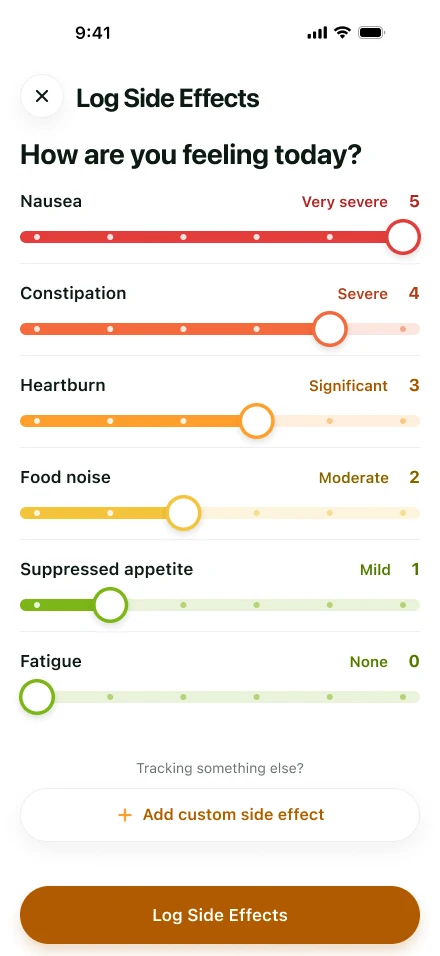
Side effects, by severity 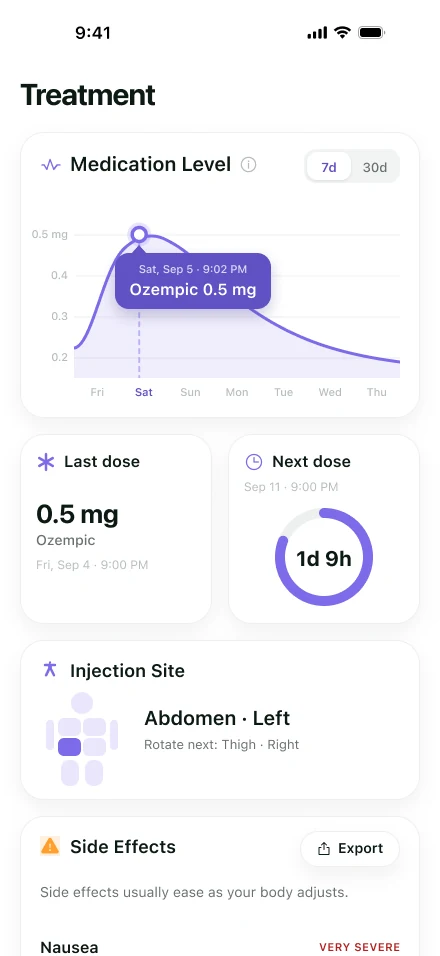
Medication level and next dose 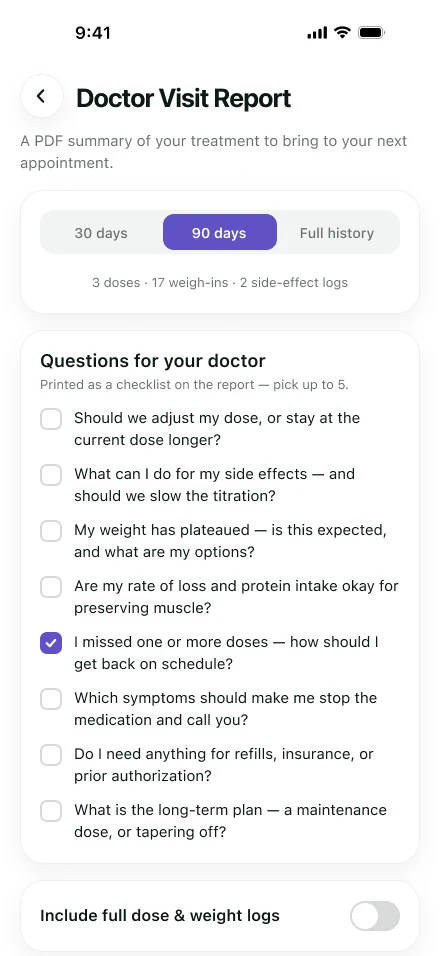
A report for your next appointment
Frequently asked questions
Are orforglipron side effects worse at higher doses?
In the label's pooled trials, most stomach side effects were more common at 9 mg and 17.2 mg than at 5.5 mg, and so was stopping because of side effects. Constipation and indigestion were highest at 9 mg.
Is orforglipron easier on the stomach than injectable GLP-1s?
No trial in the label compares them directly. Its stomach side-effect profile is broadly like other GLP-1 medicines, mostly during dose increases.
Does orforglipron cause dysesthesia like semaglutide can?
It was uncommon in the label's trials — 0.3% at 9 mg and 1% at 17.2 mg, versus 0.1% on placebo, and none at 5.5 mg.
Why does orforglipron have a thyroid warning if it didn't cause tumors in rodents?
The label explains that orforglipron isn't active at the rat and mouse GLP-1 receptor, so the rodent studies couldn't show the effect seen with other GLP-1 medicines. The boxed warning still applies, and its relevance to people hasn't been determined.
Sources
- FOUNDAYO (orforglipron) tablets — Prescribing Information (revised 7/2026) — U.S. National Library of Medicine (DailyMed)
- Orforglipron, an Oral Small-Molecule GLP-1 Receptor Agonist for Obesity Treatment (ATTAIN-1) — New England Journal of Medicine
Keep reading
- Orforglipron TrackerHow orforglipron works as a small-molecule, non-peptide oral GLP-1, what its 72-week trials found, and what's worth logging if you take it or join a study.
- Foundayo Side EffectsFoundayo (orforglipron) side effects from the FDA label — how often nausea, constipation and vomiting came up, what eases with time, and when to call your doctor.
- Moving Up a DoseWhy GLP-1 doses start low and step up every few weeks, what the Wegovy and Zepbound labels say about escalation, and what to note in the days after each step.
- GLP-1 Side EffectsThe most common GLP-1 side effects for semaglutide and tirzepatide, when they tend to appear, which warning signs need a doctor, and how tracking helps.