
Mounjaro Side Effects in Type 2 Diabetes — What the Label Shows
Mounjaro side effects for people with type 2 diabetes — how common nausea and diarrhea were in trials, low blood sugar with insulin, eye checks and when to get help.
Worth remembering
- Stomach side effects were the most common in trials and were more frequent at higher doses.
- Most nausea, vomiting and diarrhea happened during dose escalation and decreased over time.
- Low blood sugar is mainly a concern alongside insulin or a sulfonylurea, and your prescriber may adjust those.
- If you have diabetic retinopathy, the label asks for monitoring, because fast glucose improvement can briefly worsen it.
- Log symptoms against your dose days so your diabetes team sees the real pattern.
You moved up to 7.5 mg on Sunday, and by Tuesday your lunch is sitting heavier than usual. You check your glucose meter, which looks better than it has in months, and wonder whether the queasy feeling is just the price of that. Here is what the Mounjaro label actually says, with a type 2 diabetes lens.
Which side effects are most common on Mounjaro?
The label pools placebo-controlled trials in adults with type 2 diabetes and lists the side effects that showed up in at least 5% of people on Mounjaro and more often than on placebo.
| Side effect | Placebo | 5 mg | 10 mg | 15 mg |
|---|---|---|---|---|
| Nausea | 4% | 12% | 15% | 18% |
| Diarrhea | 9% | 12% | 13% | 17% |
| Decreased appetite | 1% | 5% | 10% | 11% |
| Vomiting | 2% | 5% | 5% | 9% |
| Constipation | 1% | 6% | 6% | 7% |
| Indigestion (dyspepsia) | 3% | 8% | 8% | 5% |
| Stomach pain | 4% | 6% | 5% | 5% |
Taken together, stomach-related side effects were reported by 37% to 44% of people on Mounjaro, depending on dose, compared with about 20% on placebo. Between 3% and 6.6% stopped treatment because of them, versus 0.4% on placebo.
Why does it often feel worse after a dose step?
The label says most nausea, vomiting and diarrhea happened during dose escalation and decreased over time. That is the reason for its slow schedule: 2.5 mg for 4 weeks, then 5 mg, and any further 2.5 mg steps at least 4 weeks apart.
It also lists smaller stomach effects that were more common on Mounjaro, including burping, gas, reflux and bloating. None of these is dramatic on its own, but they add up, and they are easier to discuss when you have written them down.
What about low blood sugar?
This is the side effect that matters most with diabetes. On its own, Mounjaro rarely caused low readings in the label's monotherapy trial. The picture changes when it is combined with medicines that push insulin up.
When added to basal insulin, readings below 54 mg/dL were reported in 14% to 19% of people on Mounjaro, compared with 13% on placebo. The label also describes more lows when Mounjaro is used with a sulfonylurea, and says lowering the dose of the insulin or sulfonylurea may be needed. That decision belongs to your prescriber.
Are there diabetes-specific risks to watch?
Two stand out for people with type 2 diabetes.
- Diabetic retinopathy. Rapid improvement in glucose control has been linked to a temporary worsening of retinopathy. The label says Mounjaro has not been studied in some advanced forms and asks that anyone with a history of retinopathy be monitored. Keep your eye appointments.
- Dehydration and the kidneys. The label describes acute kidney injury, mostly in people who became dehydrated from vomiting or diarrhea. Kidney function may be checked if this happens, especially when doses are going up.
Other warnings on the label include acute pancreatitis, gallbladder problems, serious allergic reactions, severe stomach side effects, and a risk of breathing in stomach contents under anesthesia — so tell anyone planning a procedure that you take Mounjaro. The label also carries a boxed warning about thyroid C-cell tumors seen in rats; it is unknown whether this applies to people, and Mounjaro is not for anyone with a personal or family history of medullary thyroid carcinoma or MEN 2.
What we'd track
For Mounjaro side effects, these are the notes we would keep.
- Symptoms against dose days. Rate nausea, reflux and bowel changes each day so you can see whether they peak after a step and fade.
- Every low glucose reading. Time, number and what you had eaten — particularly if you use insulin or a sulfonylurea.
- Fluids. If you are vomiting or have diarrhea, a simple water log shows whether you are keeping up.
- Meals and protein. Decreased appetite is on the label; a photo log makes it obvious if you are barely eating.
- Anything new. Rashes, injection-site reactions or vision changes, with the date they started.
Holt lines your side effects up against your shot days, logs water and meals by photo, and builds a doctor-visit report on your iPhone. It is free to download, with an optional subscription.
See your side effects next to your doses in HoltSee it in Holt
Real screens from the app — the same places you’ll log, review and share.
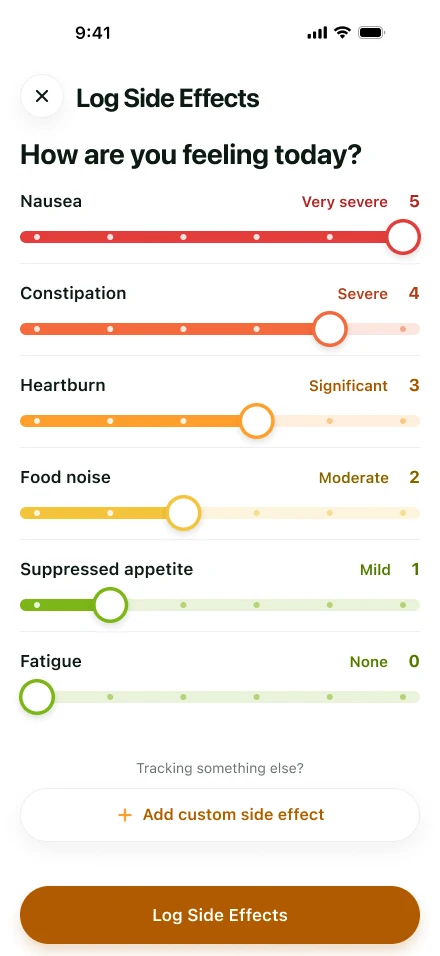
Side effects, by severity 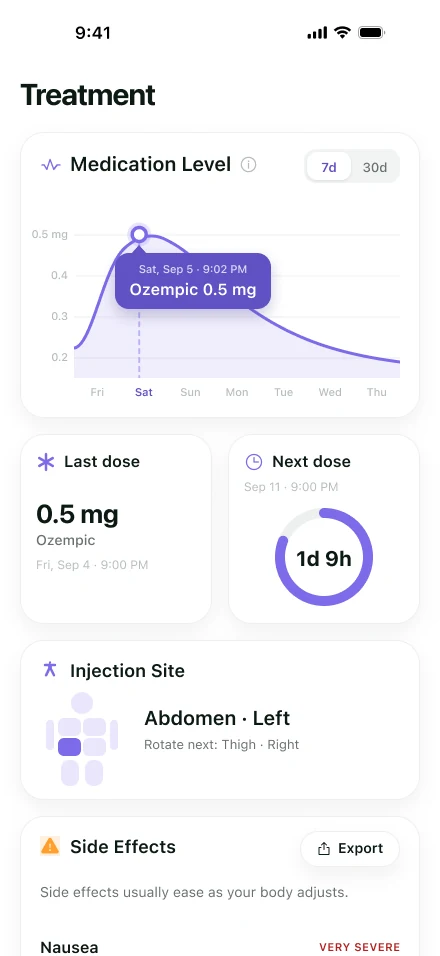
Medication level and next dose 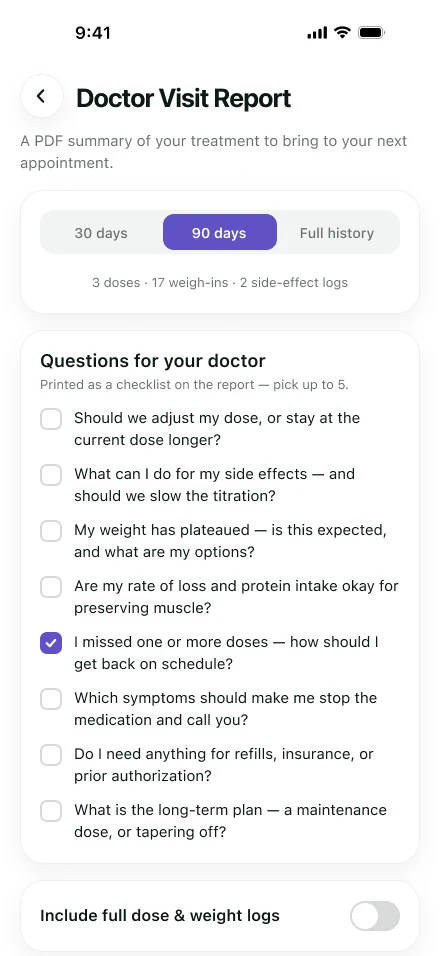
A report for your next appointment
Frequently asked questions
How long does Mounjaro nausea last?
The label does not give a set number of days. It says most nausea, vomiting and diarrhea happened during dose escalation and decreased over time; if it is not settling, talk to your prescriber.
Can Mounjaro cause low blood sugar on its own?
In the label's 40-week monotherapy trial, readings below 54 mg/dL were reported in 0% of people on Mounjaro and 1% on placebo. The risk rises when it is used with insulin or a sulfonylurea.
Does Mounjaro affect my birth control pill?
The label says Mounjaro can reduce how well oral contraceptives work around the start of treatment and dose increases. It advises switching to a non-oral method or adding a barrier method for 4 weeks after starting and for 4 weeks after each dose increase.
Will Mounjaro affect my other tablets?
Mounjaro slows how quickly the stomach empties, and the label says this may affect how other oral medicines are absorbed. Ask your pharmacist whether any of yours need closer monitoring.
Sources
- Mounjaro (tirzepatide) injection — Prescribing Information — U.S. Food and Drug Administration
Keep reading
- Mounjaro TrackerA calm way to log weekly Mounjaro shots for type 2 diabetes — dose steps, the 4-day missed-dose window, injection sites and side effects, all on your iPhone.
- Tirzepatide Side EffectsTirzepatide side effects across Mounjaro and Zepbound, how they compared with semaglutide head to head, and what the FDA says about compounded versions.
- GLP-1 Side EffectsThe most common GLP-1 side effects for semaglutide and tirzepatide, when they tend to appear, which warning signs need a doctor, and how tracking helps.
- Mounjaro vs OzempicMounjaro vs Ozempic for type 2 diabetes — what each is approved for, how the dose steps and pens differ, and what the SURPASS-2 head-to-head trial found for HbA1c.