
GLP-1 Muscle Loss — How Much Is Lean Mass and How to Tell
How much of the weight lost on a GLP-1 is lean mass, what trial body scans showed, who should pay closer attention, and the signs worth tracking at home.
Worth remembering
- Lean mass includes muscle, water, organs and other tissue, so "lean mass lost" overstates muscle lost.
- In STEP 1, 5.3 kg of an average 13.6 kg weight loss was lean mass, measured by DXA scan.
- Modeling cited in the advisory suggests muscle loss may be larger, as a share, in men than in women.
- Simple tests like timed chair stands show changes in function that the scale can't.
- Protein and resistance training are the two levers the advisory recommends.
Your weight is down, your jeans fit differently, and a friend asks, half joking, "Is any of that muscle?" It's a fair question, and one that's been all over social media. The short answer is yes, some of it is. The more useful answer is how much, how you'd know, and what you can do about it.
How much of GLP-1 weight loss is lean mass?
The clearest numbers come from body scans in the trials. In STEP 1, a large trial of semaglutide 2.4 mg, a subgroup had DXA scans, an X-ray method that separates fat from lean tissue. The 2025 joint advisory from four US obesity and nutrition societies summarizes the result:
| STEP 1 body scan subgroup | Average |
|---|---|
| Total weight lost | 13.6 kg |
| Fat mass lost | 8.3 kg (62%) |
| Lean mass lost | 5.3 kg (38%) |
SURMOUNT-1, the main obesity trial of tirzepatide, also used DXA scans in a subgroup and reported reductions in both fat and lean mass. The pattern across trials is similar: most of what's lost is fat, and a meaningful share is lean mass.
Is lean mass the same as muscle?
No, and this is where a lot of online worry gets ahead of the data. Lean mass is everything that isn't fat: muscle, but also water, organs, bone and connective tissue. Some of that is expected to shrink when the body gets smaller.
The advisory's authors estimate that muscle itself accounts for around 20% of total weight lost in STEP 1. They also cite modeling which suggests that, without structured strength training, muscle loss might be about 10–15% of weight lost in women and 20–25% in men. These are estimates, not measurements of any one person.
Who should pay closer attention?
The advisory treats muscle as a priority for everyone on GLP-1 therapy, but some situations raise the stakes:
- Older adults, who already lose muscle with age
- Men, based on the modeling above
- Anyone losing weight quickly or substantially, since a bigger loss means more lean mass lost in absolute terms, and the advisory links rapid, substantial weight loss with bone loss
- People eating very little, because low protein intake during weight loss is linked with more lean mass loss
- People who aren't currently active
None of these is a reason to avoid treatment. They're reasons to have the conversation with your prescriber early.
How can I tell if I'm losing muscle?
The scale can't tell you. A falling number looks the same whether it's fat, water or muscle. The advisory suggests a few ways to look closer:
- Body composition scans. DXA is described as a gold standard and may be considered every one to two years. Bioelectrical impedance (the technology in many smart scales and some clinic devices) is more practical for repeat checks, though readings shift with hydration.
- Function tests. The advisory mentions sit-to-stand, stair-climb and timed up-and-go tests. These are simple enough to repeat at home: how many times can you stand up from a chair in 30 seconds?
The advisory also notes an important limit: these tools measure muscle mass, not muscle health, quality or function. Getting stronger while getting lighter is a good sign, whatever a scan says.
What does the guidance recommend?
Two things, together. On protein, the advisory says higher intakes of 1.2–1.6 g per kg of body weight a day have been proposed during active weight reduction, with 80–120 g a day as a simpler range. Those are figures to discuss with your clinician, especially if you have kidney disease. Our free protein calculator gives a starting range.
On exercise, it recommends strength training at least three times a week plus at least 150 minutes of moderate aerobic activity. We cover how to start in strength training on a GLP-1.
What we'd track
- Protein each day. The advisory links low protein with more lean mass loss. Seeing your daily number against a goal shows whether you're consistently short.
- Strength and activity. Workouts and steps, so you can see whether three strength sessions a week is happening.
- A monthly function test. Chair stands in 30 seconds, or stairs climbed without stopping.
- Weight trend, not daily weight. A steady trend alongside steady or improving strength is the picture you're after.
- Any body composition results. Note the date and method, and compare like with like.
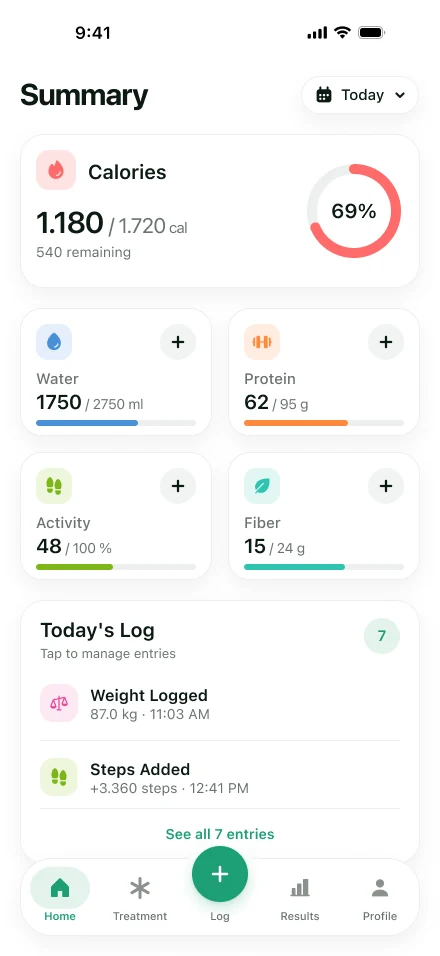
Holt's home Summary shows protein and activity against your daily goals, alongside calories, water and fiber. Workouts, steps and weigh-ins sync from Apple Health, and the Results screen shows your weekly average and trend. The doctor-visit report puts it together for your appointment.
Keep protein and activity in view with HoltSee it in Holt
Real screens from the app — the same places you’ll log, review and share.
Your day at a glance 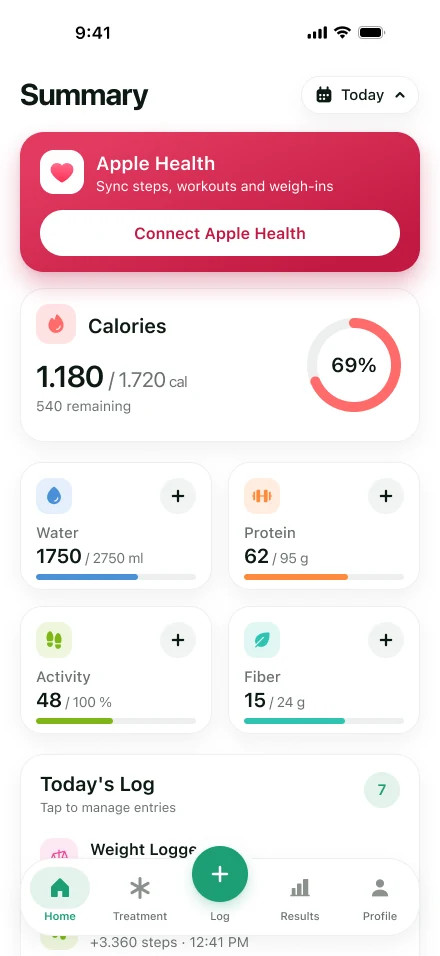
Syncs with Apple Health 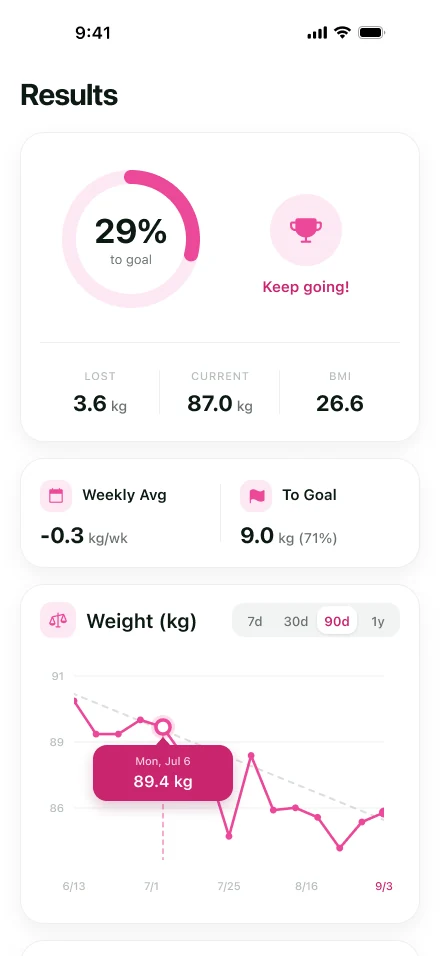
Progress toward your goal
Frequently asked questions
Is muscle loss on a GLP-1 worse than with other weight loss?
Losing some lean mass is expected with weight loss of most kinds. GLP-1s can produce large losses, so the advisory recommends planning for it from the start with adequate protein and strength training.
Should I get a DXA scan?
The 2025 advisory calls DXA a gold standard and suggests it may be considered every one to two years, with bioelectrical impedance as a more practical option for repeat checks. Whether it's worth it for you is a question for your clinician.
Do smart scales measure muscle accurately?
Home scales use a form of bioelectrical impedance, which gives estimates that can shift with hydration. They're more useful for trends over weeks than single readings. The advisory notes these tools measure muscle mass but not its quality or function.
Will eating more protein stop muscle loss?
Protein helps, but the advisory pairs it with resistance training for a reason. Muscle needs both the material and a reason to keep it. Ask your clinician or a dietitian for a protein target that suits your health.
Sources
- Nutritional priorities to support GLP-1 therapy for obesity: a joint Advisory from the American College of Lifestyle Medicine, the American Society for Nutrition, the Obesity Medicine Association, and The Obesity Society — Obesity (Silver Spring), 2025
- Once-weekly semaglutide in adults with overweight or obesity (STEP 1; Wilding et al.) — New England Journal of Medicine, 2021
- Tirzepatide once weekly for the treatment of obesity (SURMOUNT-1; Jastreboff et al.) — New England Journal of Medicine, 2022
Keep reading
- Protein, Fiber & Water TrackerTrack the three nutrients most likely to slip on a GLP-1 — protein, fiber and water — against daily goals, with general reference ranges from primary sources.
- GLP-1 Progress TrackerA GLP-1 progress tracker that shows percent to goal, weekly averages and trends, plus strength, habits and how you feel — progress the daily weigh-in misses.
- GLP-1 Food TrackerA GLP-1 food tracker that logs meals from a photo, estimates calories and protein, and shows how what you ate lines up with shot days and side effects.
- GLP-1 Tracker AppHolt is a GLP-1 tracker app for iPhone. Log shots and pills, meals, protein, side effects, weight and water, and see how your dose day shapes your week.