
Tirzepatide Side Effects — Dual GIP/GLP-1 and Compounded Doses
Tirzepatide side effects across Mounjaro and Zepbound, how they compared with semaglutide head to head, and what the FDA says about compounded versions.
Worth remembering
- Mounjaro and Zepbound share one molecule, so their warnings are nearly the same; their side-effect rates differ mainly because the trial populations differed.
- Stomach side effects cluster around dose increases on both labels.
- In SURPASS-2, stomach side effects on tirzepatide and semaglutide 1 mg were in a similar range.
- The FDA has received more than 730 adverse event reports for compounded tirzepatide as of May 31, 2026.
- Knowing exactly which product and dose you took is the first thing a clinician will ask.
A friend on semaglutide says the first months were rough on her stomach, and you are wondering whether tirzepatide, which works on two hormones instead of one, will be worse. Or perhaps your tirzepatide came from a compounding pharmacy and you want to know what is normal. Both questions have real answers in the labels and trials, so let's go through them.
Does acting on two hormones mean more side effects?
Tirzepatide activates both GIP and GLP-1 receptors, while semaglutide works on GLP-1 alone. It is tempting to assume "two" means "twice the side effects," but the evidence does not say that.
The one large head-to-head trial in type 2 diabetes, SURPASS-2, compared three tirzepatide doses with semaglutide 1 mg over 40 weeks. The stomach side effects came out in a similar range:
| Side effect (SURPASS-2) | Tirzepatide 5–15 mg | Semaglutide 1 mg |
|---|---|---|
| Nausea | 17% to 22% | 18% |
| Diarrhea | 13% to 16% | 12% |
| Vomiting | 6% to 10% | 8% |
Most of these were mild to moderate. Serious adverse events were reported in 5% to 7% of people on tirzepatide and 3% on semaglutide. These are averages from one trial; they do not tell you how your own body will respond.
Why do Mounjaro and Zepbound list different numbers?
Because they come from different people. The Mounjaro label pools trials in adults with type 2 diabetes; the Zepbound label pools trials in adults with obesity or overweight, mostly without diabetes.
| Side effect | Mounjaro trials (5–15 mg) | Zepbound trials (5–15 mg) |
|---|---|---|
| Nausea | 12% to 18% | 25% to 29% |
| Diarrhea | 12% to 17% | 19% to 23% |
| Vomiting | 5% to 9% | 8% to 13% |
| Constipation | 6% to 7% | 11% to 17% |
The Zepbound label also lists injection-site reactions, fatigue, hair loss and reflux among its most common effects. Both labels agree on the timing: most nausea, vomiting and diarrhea happened during dose escalation and decreased over time.
Which serious risks apply to all tirzepatide?
The warnings are almost identical on both labels:
- severe stomach side effects, and tirzepatide is not recommended with severe gastroparesis;
- acute kidney injury, mainly after dehydration from vomiting or diarrhea;
- gallbladder problems and acute pancreatitis;
- serious allergic reactions, including anaphylaxis and swelling;
- low blood sugar, mainly with insulin or a sulfonylurea;
- worsening of diabetic retinopathy in people who already have it;
- breathing in stomach contents during anesthesia or deep sedation.
Both carry a boxed warning about thyroid C-cell tumors seen in rats; whether this applies to people is unknown. Tirzepatide is not for anyone with a personal or family history of medullary thyroid carcinoma or MEN 2.
What about side effects with compounded tirzepatide?
Compounded tirzepatide has not been through FDA review for safety, effectiveness or quality, so there is no label table for it. The FDA has published what it is seeing instead: more than 730 adverse event reports for compounded tirzepatide as of May 31, 2026, which the agency says likely undercounts the real number.
The FDA also describes reports of dosing errors with compounded GLP-1 injections — people measuring the wrong amount, or professionals miscalculating — some of which led to hospital care. If side effects suddenly feel stronger after a new vial or refill, that is worth a call to your pharmacist or prescriber.
What we'd track
For tirzepatide side effects, here is what we would write down, and why.
- Product, dose and date. Mounjaro, Zepbound or compounded, plus the milligram dose — the first thing any clinician will ask.
- Daily stomach ratings. To see whether symptoms rise after each step and fade, as the labels describe.
- Fluids. Dehydration ties several serious warnings together.
- Injection site and any reaction. So patterns at one spot stand out.
- New vials or refills. If you use a compounded product, a change in how you feel right after a new vial is useful information.
Holt places side effects against your shot days, keeps water and meal logs, and builds a doctor-visit report on your iPhone. It is free to download, with an optional subscription.
Track tirzepatide side effects with HoltSee it in Holt
Real screens from the app — the same places you’ll log, review and share.
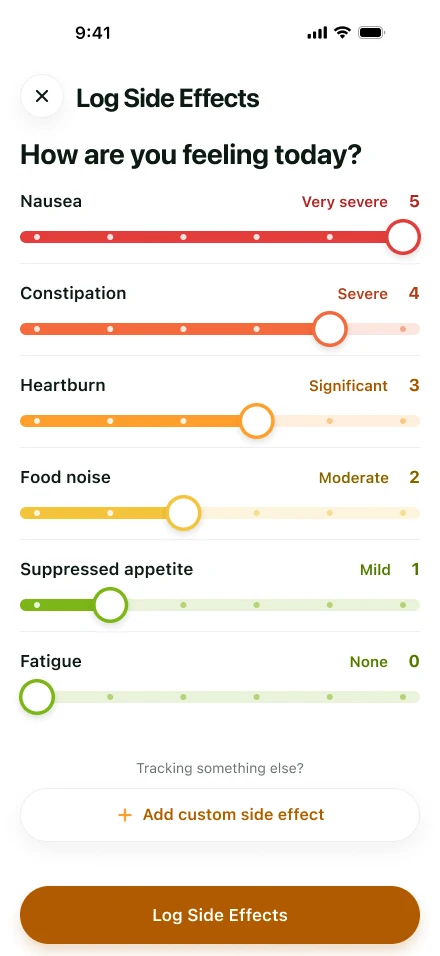
Side effects, by severity 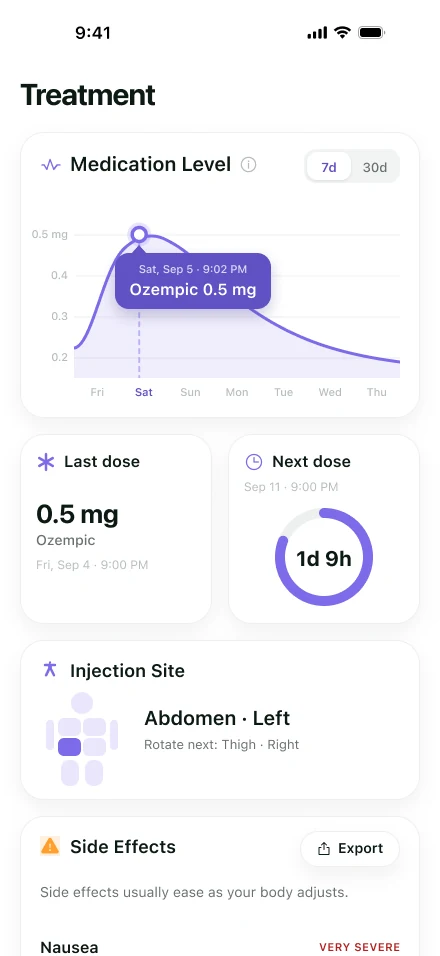
Medication level and next dose 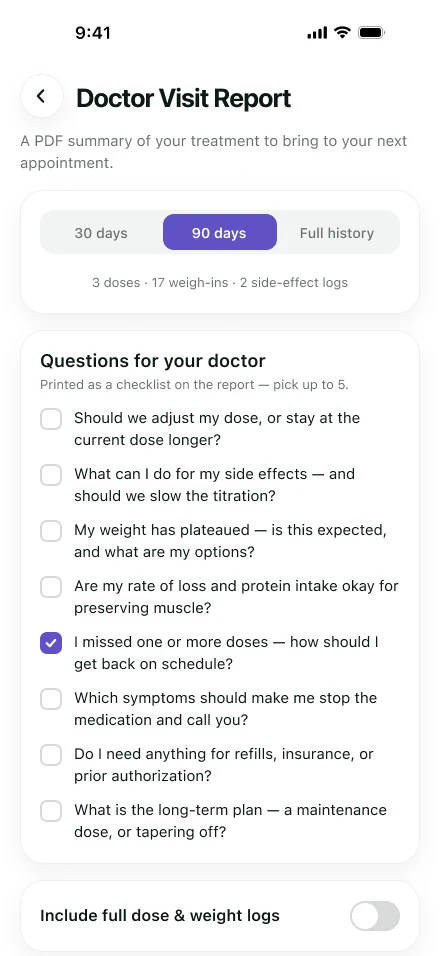
A report for your next appointment
Frequently asked questions
Is tirzepatide harder on the stomach than semaglutide?
In SURPASS-2, nausea was reported by 17% to 22% on tirzepatide and 18% on semaglutide 1 mg, diarrhea by 13% to 16% versus 12%, and vomiting by 6% to 10% versus 8%. Those are group results from one trial in type 2 diabetes, not a prediction for any one person.
Why do the Mounjaro and Zepbound labels show different side-effect rates?
The numbers come from different trials with different people — mostly adults with type 2 diabetes for Mounjaro, and adults with obesity or overweight for Zepbound. The medicine is the same; the context is not.
Are side effects worse with compounded tirzepatide?
There are no FDA-reviewed trials of compounded products to compare. What the FDA does describe is adverse event reports, some involving hospitalization, that may be linked to dosing errors with compounded GLP-1 injections.
Why do injection-site reactions happen?
The Zepbound label reports injection-site reactions in 6% to 8% of people, and they were more frequent in people who developed antibodies to tirzepatide. Rotating sites, as the label asks, also helps you see whether one spot is the problem.
Sources
- Mounjaro (tirzepatide) injection — Prescribing Information — U.S. Food and Drug Administration
- Zepbound (tirzepatide) injection — Prescribing Information — U.S. Food and Drug Administration
- Tirzepatide versus Semaglutide Once Weekly in Patients with Type 2 Diabetes (SURPASS-2) — New England Journal of Medicine
- FDA's concerns with unapproved GLP-1 drugs used for weight loss — U.S. Food and Drug Administration
Keep reading
- Tirzepatide TrackerHow to track tirzepatide, the dual GIP/GLP-1 medicine behind Mounjaro and Zepbound, and what to write down if your tirzepatide comes from a compounding pharmacy.
- Mounjaro Side EffectsMounjaro side effects for people with type 2 diabetes — how common nausea and diarrhea were in trials, low blood sugar with insulin, eye checks and when to get help.
- Zepbound Side EffectsZepbound side effects from the weight-management and sleep apnea trials — how often nausea, hair loss and fatigue came up, what eases with time and when to get help.
- Semaglutide vs TirzepatideSemaglutide vs tirzepatide — one hormone target or two, the brands behind each, and what the SURPASS-2 and SURMOUNT-5 head-to-head trials found.