
GLP-1 for PCOS — What the Evidence Says So Far
GLP-1 medications aren't approved to treat PCOS. Here's what trials and guidelines say about weight and metabolic effects, what's still unknown, and what to track.
Worth remembering
- GLP-1s are approved for weight management and type 2 diabetes, not for PCOS itself.
- Trials in PCOS are mostly small and short, and mostly used older GLP-1s like exenatide and liraglutide.
- A 2025 meta-analysis found reductions in weight and BMI but no clear overall change in testosterone.
- Pregnancy plans and birth control need a conversation with your prescriber before you start.
You've had the PCOS diagnosis for years. You've tried the eating plans, maybe metformin, and you've watched friends start a GLP-1 and talk about it constantly. Now you're wondering whether it would be different for you — and whether it would do anything for the parts of PCOS that aren't about weight.
That's a fair question, and the honest answer is that we know some things and not others.
Is a GLP-1 a treatment for PCOS?
No. No GLP-1 medication is FDA-approved to treat polycystic ovary syndrome. They're approved for uses like long-term weight management and type 2 diabetes, depending on the medication.
What that means in practice: a prescriber may suggest a GLP-1 to someone with PCOS because of their weight or metabolic health, under the normal approval for that use. Prescribing one to treat PCOS itself — cycles, androgens, fertility — would be off-label, and the evidence for those goals is still developing.
What do the guidelines say?
The 2023 international evidence-based guideline for PCOS says that alongside lifestyle support, anti-obesity medicines can be considered for weight management in adults with PCOS — following the same guidance used for the general population.
That recommendation was based on consensus, not on strong PCOS-specific evidence. The systematic review written to inform the guideline found eleven trials and noted that, for most outcomes, there wasn't enough data to pool. Liraglutide, semaglutide and orlistat did better than placebo for weight-related measures.
What have trials in PCOS actually found?
The most complete recent picture we found is a 2025 meta-analysis in Scientific Reports that pooled 13 randomized trials comparing GLP-1s with metformin or placebo in women with PCOS.
| What was measured | What the analysis found |
|---|---|
| Weight and BMI | Reduced compared with metformin and placebo |
| Waist measurements | Reduced |
| Insulin resistance (HOMA-IR) | Reduced overall; clearer against metformin than placebo |
| Testosterone and related hormones | No significant overall difference |
| Side effects | More nausea, vomiting and dizziness |
The details matter as much as the headline. Most participants took exenatide or liraglutide; only a small number took semaglutide. Trials ran for 12 to 32 weeks and were mostly small, and results varied a lot between studies. None of that tells us what happens over years, or with newer medications.
What about pregnancy and birth control?
This is the part not to skip. Many people with PCOS are thinking about fertility, now or later.
The Wegovy label says to stop the medication at least 2 months before a planned pregnancy, because semaglutide stays in the body for a long time. The Zepbound Medication Guide says it may harm an unborn baby and asks you to tell your provider if you become pregnant.
Birth control matters too. The Zepbound label advises people using oral hormonal contraceptives to switch to a non-oral method, or add a barrier method, for 4 weeks after starting and for 4 weeks after each dose increase. That's relevant if the pill is part of how your PCOS is managed. Your prescriber can tell you how this applies to your medication.
Will the side effects be different with PCOS?
There's no evidence they're fundamentally different. Stomach side effects — nausea, vomiting, constipation, diarrhea — are the most common on GLP-1 labels, and the PCOS trials showed more nausea and vomiting too. Starting low and stepping up slowly is how the labels aim to reduce them.
What we'd track
- Your cycles. Start dates and length, in whatever cycle tracker you already use. Even though trials haven't settled the question, your own record is real information for your clinician.
- Doses and side effects together. Seeing nausea against dose days helps your prescriber judge each step up.
- Weight trend, not single readings. PCOS can make weight frustrating; a weekly trend is calmer and more useful than daily numbers.
- Meals and protein. Smaller appetites can crowd out protein and fiber. A quick photo log keeps that visible.
- Questions as they come up. Birth control, pregnancy plans, symptoms that change. Note them so they make it to the appointment.
Holt keeps doses, side effects, weight trend and meals on one timeline, so you can see how each part moves alongside the others. The doctor-visit report brings it together on one page.
Keep your PCOS notes and doses in HoltNone of this replaces your endocrinologist or gynecologist. It just means you arrive with a clearer picture than memory alone can give.
See it in Holt
Real screens from the app — the same places you’ll log, review and share.
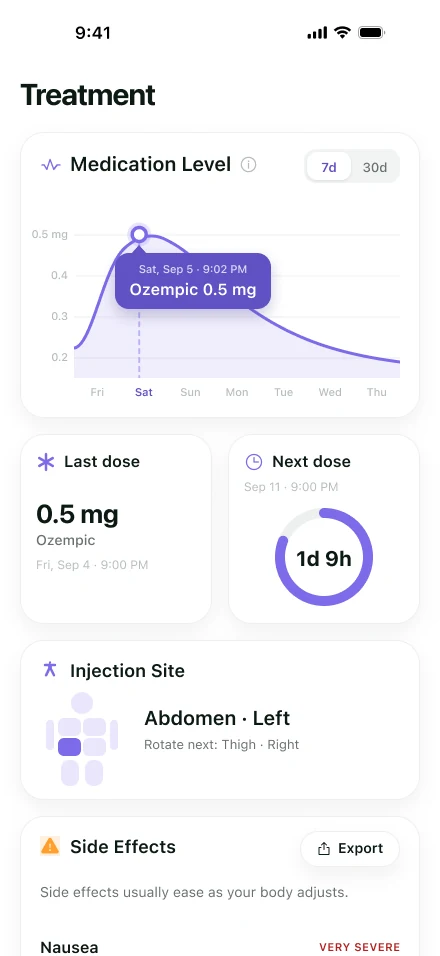
Medication level and next dose 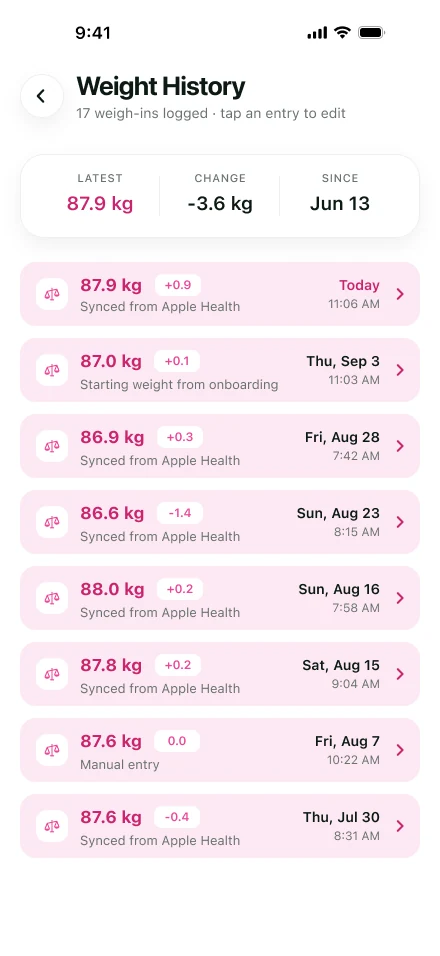
Weight history 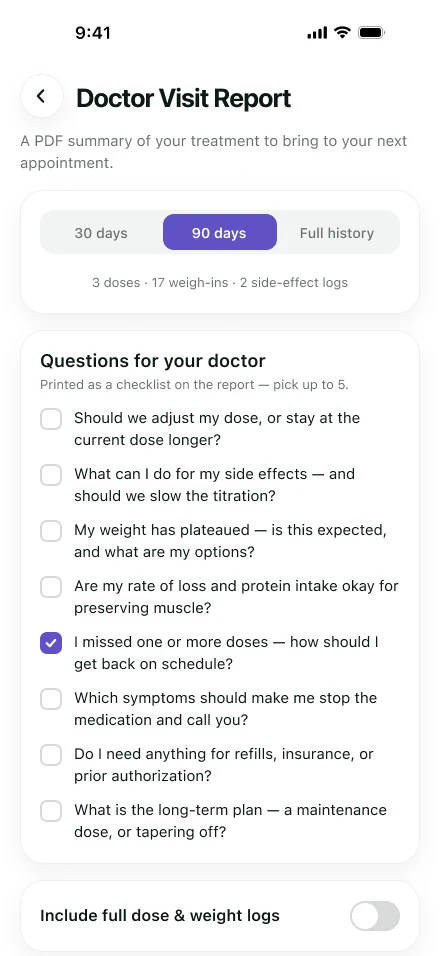
A report for your next appointment
Frequently asked questions
Is semaglutide or tirzepatide approved for PCOS?
No. They're approved for other uses, such as weight management. A prescriber may consider one for weight in someone with PCOS, but treating PCOS itself would be off-label.
Will a GLP-1 make my periods regular?
The evidence isn't strong enough to say. Some small studies have looked at cycles, but a 2025 meta-analysis of randomized trials didn't report pooled menstrual outcomes, and certainty remains low.
Can I take a GLP-1 if I'm trying to get pregnant?
Talk to your prescriber before trying. The Wegovy label says to stop at least 2 months before a planned pregnancy, and the Zepbound label says it may harm an unborn baby.
Does a GLP-1 affect birth control pills?
The Zepbound label advises people on oral hormonal birth control to switch to a non-oral method, or add a barrier method, for 4 weeks after starting and after each dose increase. Ask your prescriber what applies to your medication.
Sources
- Efficacy and safety of GLP-1 receptor agonists on weight management and metabolic parameters in PCOS women: a meta-analysis of randomized controlled trials (Lin et al.) — Scientific Reports, 2025
- Recommendations from the 2023 international evidence-based guideline for the assessment and management of polycystic ovary syndrome (Teede et al.) — Human Reproduction, 2023
- Anti-obesity pharmacological agents for polycystic ovary syndrome: a systematic review and meta-analysis to inform the 2023 international evidence-based guideline (Goldberg et al.) — Obesity Reviews, 2024
- WEGOVY (semaglutide) prescribing information — DailyMed, U.S. National Library of Medicine
- ZEPBOUND (tirzepatide) prescribing information — DailyMed, U.S. National Library of Medicine
Keep reading
- GLP-1 Tracker AppHolt is a GLP-1 tracker app for iPhone. Log shots and pills, meals, protein, side effects, weight and water, and see how your dose day shapes your week.
- Semaglutide vs TirzepatideSemaglutide vs tirzepatide — one hormone target or two, the brands behind each, and what the SURPASS-2 and SURMOUNT-5 head-to-head trials found.
- GLP-1 Side EffectsThe most common GLP-1 side effects for semaglutide and tirzepatide, when they tend to appear, which warning signs need a doctor, and how tracking helps.
- GLP-1 and MenopauseGLP-1s don't treat menopause, but many people start one around midlife. What the labels and research say about weight, muscle, bone and hormone therapy.