
GLP-1 Food Noise — What It Is and What Research Says So Far
Food noise means persistent, unwanted thoughts about food. What early research says about GLP-1 medications and food noise, what's unproven, and how to log it.
Worth remembering
- Food noise is a patient-coined term; researchers only began defining and measuring it in 2025.
- Trials show GLP-1s reduce hunger and cravings, which overlaps with — but isn't the same as — food noise.
- Whether GLP-1s act on food noise directly is still an open research question.
- Logging it with a simple 0–10 rating gives you and your clinician real data instead of a vague impression.
You notice it on a Thursday afternoon. Normally by now you'd have thought about the biscuits in the drawer a dozen times, planned dinner twice and wondered about a snack on the way home. Today, nothing. Not willpower — just quiet. People on GLP-1 medications often describe this moment, and the word they reach for is "food noise."
What is food noise, exactly?
It started as a patient's phrase, not a medical one. Researchers have only recently tried to pin it down.
A 2025 expert panel writing in Nutrition & Diabetes proposed this definition: persistent thoughts about food that the person perceives as unwanted and/or dysphoric (unpleasant). They distinguish it from ordinary thinking about food by how intense and intrusive it is, and compare it to rumination. The same year, a team publishing in Obesity described it as persistent, intrusive thoughts about food that disrupt daily life and make healthy behaviors harder.
Both groups are clear that this is new territory. The panel wrote that a formal clinical definition and method of measurement are still lacking.
Can food noise be measured?
It's starting to be. The Food Noise Questionnaire, published in Obesity in 2025, has five statements, each rated from 0 (strongly disagree) to 4 (strongly agree), for a total between 0 and 20. Higher scores mean more food noise. The authors tested it in 400 adults and found it reliable and valid, while noting that more research is needed on how useful it is in clinical care.
The expert panel is developing a separate, longer inventory, which wasn't yet validated when their paper was published.
What does research say about GLP-1s and food noise?
Here's where we want to be careful, because headlines run ahead of the evidence.
| What's been shown | What hasn't, yet |
|---|---|
| In a 20-week trial of 72 adults, semaglutide 2.4 mg reduced hunger and food cravings and improved reported control of eating versus placebo | A published randomized trial measuring food noise itself as the outcome |
| People ate about 35% less at a test lunch on semaglutide than on placebo | Whether the effect differs between medications or doses |
| The 2025 joint advisory notes reduced "food noise," emotional eating and binge episodes reported with GLP-1 therapy | How long any change lasts, or what happens after stopping |
The expert panel describes the evidence on food noise specifically as mostly anecdotal and hypothesis-generating, and calls the question of whether GLP-1s affect it directly an open one. That doesn't mean people's experiences aren't real. It means the research is still catching up to them.
Is less food noise always good?
Mostly it's welcome. But a very quiet appetite has its own risk: the advisory describes people eating too little to meet protein and nutrient needs during GLP-1 therapy. Quiet shouldn't mean skipped meals for days at a time.
It's also worth knowing that food noise overlaps with, but isn't the same as, disordered eating. If thoughts about food are distressing, or you have a history of an eating disorder, mention it to your prescriber. That's useful context for your care, whichever direction things move.
What we'd track
Because there's no standard way to measure food noise in everyday life yet, your own consistent log is the most honest data you have.
- A daily food noise rating. Same scale, same time of day. Consistency matters more than precision.
- Appetite separately. Food noise and hunger aren't identical. Rating both shows whether they move together for you.
- Dose days. Lining ratings up against shots shows whether there's a weekly rhythm, which is something no study has settled.
- What you actually ate. A quiet appetite plus a thin protein log is a conversation to have with your clinician.
- Nausea alongside it. Helps separate "I'm not thinking about food" from "I feel too sick to think about food."
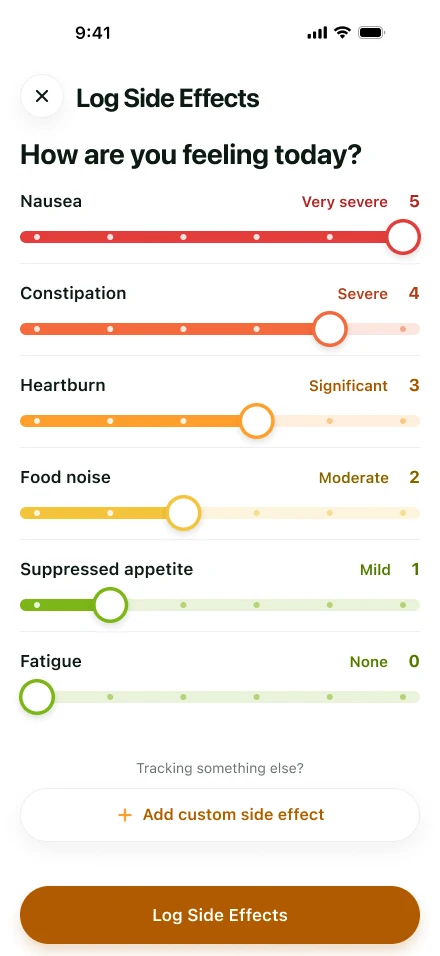
Holt's side-effect log includes severity sliders for food noise and suppressed appetite, next to nausea, constipation, heartburn and fatigue, and you can add your own. Each entry lines up against your dose days on the same timeline, so a pattern — or the lack of one — becomes visible.
Start rating food noise in HoltWhen it's time for an appointment, the doctor-visit report gathers your doses and side-effect ratings into one PDF, with suggested questions to ask.
See it in Holt
Real screens from the app — the same places you’ll log, review and share.
Side effects, by severity 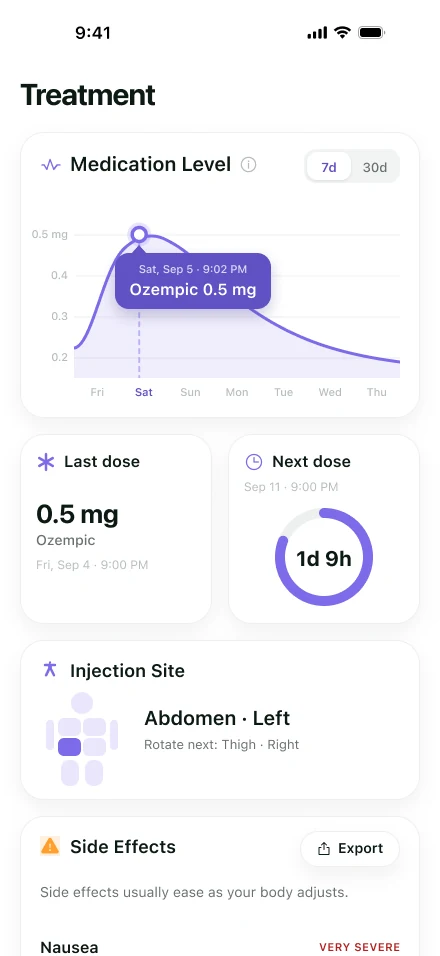
Medication level and next dose 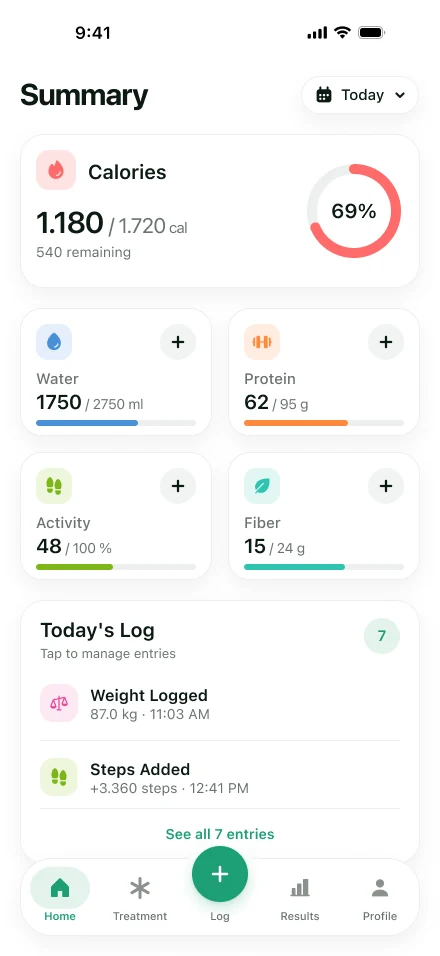
Your day at a glance
Frequently asked questions
Is food noise a medical diagnosis?
No. It's an informal term that researchers have only recently started defining. A 2025 expert panel described it as persistent thoughts about food that the person finds unwanted or distressing, and noted that a formal clinical definition is still lacking.
Do GLP-1 medications stop food noise?
Many people report that it gets quieter, and trials show reduced hunger and cravings on semaglutide. But food noise itself hasn't been measured in a published randomized trial, so we can't say how reliably or for whom it changes.
Does food noise come back before my next shot?
Some people describe that, but we couldn't find a study that has tested it. Logging food noise alongside your dose days is the most direct way to see whether there's a pattern for you.
Is it a problem if I have almost no appetite at all?
It can be, if it means you're not eating enough protein or drinking enough fluid. Tell your prescriber if you're regularly skipping meals or struggling to eat.
Sources
- Food noise: definition, measurement, and future research directions (Dhurandhar et al.) — Nutrition & Diabetes, 2025
- Development and validation of the Food Noise Questionnaire (Diktas et al.) — Obesity (Silver Spring), 2025
- The effect of semaglutide 2.4 mg once weekly on energy intake, appetite, control of eating, and gastric emptying in adults with obesity (Friedrichsen et al.) — Diabetes, Obesity and Metabolism, 2021
- Nutritional priorities to support GLP-1 therapy for obesity: a joint Advisory from the American College of Lifestyle Medicine, the American Society for Nutrition, the Obesity Medicine Association, and The Obesity Society — Obesity (Silver Spring), 2025
Keep reading
- Side Effect TrackerA GLP-1 side effect tracker for iPhone. Rate nausea, constipation, fatigue and more on a slider, add your own, and see how symptoms line up with dose days.
- GLP-1 Side EffectsThe most common GLP-1 side effects for semaglutide and tirzepatide, when they tend to appear, which warning signs need a doctor, and how tracking helps.
- GLP-1 Food TrackerA GLP-1 food tracker that logs meals from a photo, estimates calories and protein, and shows how what you ate lines up with shot days and side effects.
- GLP-1 Tracker AppHolt is a GLP-1 tracker app for iPhone. Log shots and pills, meals, protein, side effects, weight and water, and see how your dose day shapes your week.