
A dose tracker that remembers every step up
A GLP-1 dose tracker for iPhone that records every dose's strength and site, and shows your escalation history and adherence in one place.
Worth remembering
- The labels step doses up gradually — Zepbound by 2.5 mg at least 4 weeks apart, Wegovy every 4 weeks.
- Record the strength of every dose, not just the date, so your escalation history is clear.
- Adherence — doses taken out of doses scheduled — is often the first thing a prescriber asks about.
- If you draw from a vial, check the units against your pharmacy label and instructions, then log exactly what you took.
- Dose changes always come from your prescriber, never from an app.
Your prescriber asks a simple question: "When did you go up to 7.5?" You know it was after the holidays. Or was the 7.5 the one that made you queasy, and that was 5? You scroll your messages for a pharmacy text and find nothing useful.
Remembering that you took a shot is one problem. Remembering how much, and when it changed, is a different one — and it's the one that matters most at appointments.
Why track the strength, not just the date?
Because GLP-1 doses are built up in steps, and each step is a decision your prescriber makes based on how the last one went. The labels lay out the general pattern:
| Medication | How the label steps up |
|---|---|
| Zepbound (tirzepatide) | Starts at 2.5 mg weekly for 4 weeks, then increases in 2.5 mg steps at least 4 weeks apart |
| Wegovy (semaglutide injection) | Starts at 0.25 mg weekly, increasing every 4 weeks — 0.5, 1 and 1.7 mg — toward a maintenance dose |
Your schedule may differ from these if your prescriber has kept you at a dose longer or adjusted the plan. That's normal, and exactly why your own record matters more than the textbook one. We walk through the steps in more detail in our dose escalation guide.
What does adherence actually tell anyone?
Adherence is doses taken out of doses scheduled. It sounds clinical, but it answers a practical question: is the medication being given a fair chance at this strength?
If side effects seem worse than expected, a missed week or a moved shot day is one of the first things worth ruling out. If progress seems slow, the same is true. A clear "12 of 12" settles it in a sentence.
How do I double-check units from a vial?
If you use a pen, the strength is printed on it and the dose is fixed. If you draw from a vial, there's arithmetic involved: the dose in mg, the concentration in mg per mL, and the marks on your syringe.
Here's the habit we'd suggest:
- Write down what you were told. The dose in mg and the volume or units from your prescriber or pharmacy.
- Read the concentration off the vial and the pharmacy label — not from memory, and not from last month's vial.
- Check the label against what you wrote down. If the concentration or the units differ from your instructions, or anything is unclear, ask your pharmacist or prescriber.
- If they don't match, stop and call before injecting. Don't split the difference.
- Log the dose exactly as you took it in Holt, so your record matches the label and the instructions you were given.
Holt doesn't work out or check the conversion for you — the pharmacy label and your pharmacist's instructions are the reference. What Holt does is keep an exact record of every dose you log, so if a question comes up later, you and your prescriber can see what was taken and when.
How does Holt's Dose History handle this?
Every dose you log is saved with its strength and injection site. The Dose History screen lists them in order, with your start date and an adherence count such as 12/12, so the escalation story reads top to bottom: four weeks at one strength, the step up, four more weeks.
On the Treatment screen you'll see "Last dose" and "Next dose" with a countdown, and an estimated medication-level chart over 7 or 30 days — a picture of the rhythm of your weekly doses, not a lab result.
What we'd track
- The strength of every dose. In mg, every time — this is your escalation history.
- The date each new strength started. The single most-asked question at follow-ups.
- Missed or moved doses. They explain a lot about side effects and progress.
- How you felt in the first two weeks at each strength. That's when side effects tend to show up, and it's what your prescriber weighs before the next step — our side effect tracker page covers how to log it.
Holt keeps all four in one place and folds them into a Doctor Visit Report — a PDF covering 30 days, 90 days or your full history, with suggested questions for your appointment.
Keep your dose history in HoltSee it in Holt
Real screens from the app — the same places you’ll log, review and share.
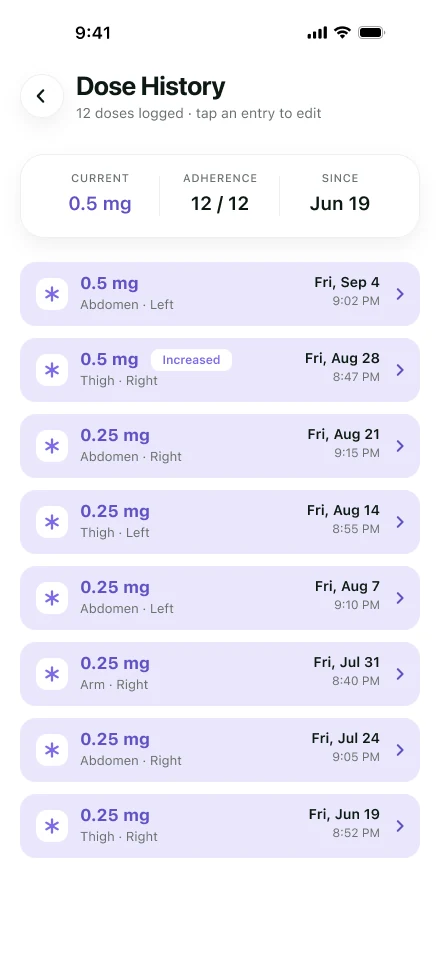
Every dose, every site 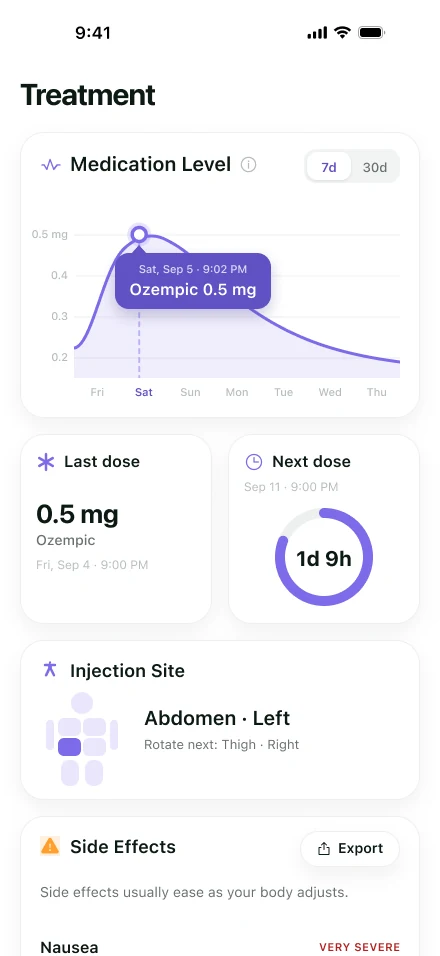
Medication level and next dose 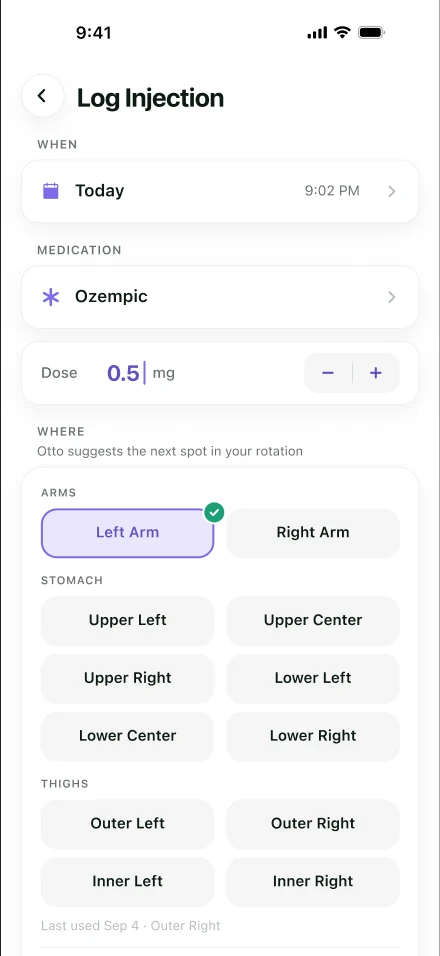
Otto suggests your next site
Frequently asked questions
Will Holt tell me when to increase my dose?
No. Holt records the doses your prescriber has set and shows your history. Decisions about stepping up, staying put or stepping down are made with your prescriber.
Can I log compounded semaglutide or tirzepatide?
Yes. You can log any semaglutide or tirzepatide medication, branded or compounded, with your own dose and schedule.
What if I missed a dose — does adherence drop?
Your adherence shows doses logged against doses scheduled, so a missed week shows up honestly. For what to do about the missed dose itself, follow your label or ask your pharmacist — the rules differ between medications.
Sources
- ZEPBOUND (tirzepatide) prescribing information, Medication Guide and Instructions for Use — DailyMed, U.S. National Library of Medicine
- WEGOVY (semaglutide) prescribing information, Medication Guide and Instructions for Use — DailyMed, U.S. National Library of Medicine
Keep reading
- Moving Up a DoseWhy GLP-1 doses start low and step up every few weeks, what the Wegovy and Zepbound labels say about escalation, and what to note in the days after each step.
- GLP-1 Shot TrackerA GLP-1 shot tracker for iPhone that logs each weekly dose, rotates injection sites, reminds you on shot day and lines up side effects with dose days.
- Side Effect TrackerA GLP-1 side effect tracker for iPhone. Rate nausea, constipation, fatigue and more on a slider, add your own, and see how symptoms line up with dose days.
- GLP-1 Tracker AppHolt is a GLP-1 tracker app for iPhone. Log shots and pills, meals, protein, side effects, weight and water, and see how your dose day shapes your week.