
Mounjaro Tracker for Type 2 Diabetes — Doses, Steps and Symptoms
A calm way to log weekly Mounjaro shots for type 2 diabetes — dose steps, the 4-day missed-dose window, injection sites and side effects, all on your iPhone.
Worth remembering
- Mounjaro is approved for type 2 diabetes; the 2.5 mg starting dose is for getting started, not for glucose control.
- Dose steps come at least 4 weeks apart, so a log of when each step began is genuinely useful.
- A missed dose can be taken within 4 days (96 hours); after that, the label says skip it and keep your usual day.
- Rotating sites each week is part of the label, and it is much easier when the last site is written down.
- Bring your log to diabetes appointments, but your prescriber decides every dose change.
It is Thursday evening, the pen is out of the fridge, and you cannot quite remember whether last week was your fourth week on 2.5 mg or your fifth. Your next diabetes appointment is in a month, and you would like to walk in with more than "I think it has been fine." That is the whole reason a Mounjaro tracker exists.
What is Mounjaro actually approved for?
Mounjaro is tirzepatide, a once-weekly injection approved as an add-on to diet and exercise to improve blood sugar control in type 2 diabetes. The current label covers adults and children 10 years and older. It is a different brand from Zepbound, which uses the same medicine for weight management and sleep apnea.
That distinction shapes what is worth tracking. With Mounjaro, the conversation with your care team usually centres on glucose and HbA1c, with weight, appetite and stomach symptoms as part of the picture rather than the headline.
How does the dose schedule work?
The label lays out a slow climb, and the dates matter more than people expect.
| Step | Weekly dose | What the label says |
|---|---|---|
| Start | 2.5 mg | For 4 weeks; meant for starting treatment, not for glucose control |
| First increase | 5 mg | After 4 weeks on 2.5 mg |
| Further steps | 7.5, 10, 12.5 mg | Only if more glucose control is needed, at least 4 weeks on each |
| Adult maximum | 15 mg | Children 10+: maximum 10 mg |
The label explains the gentle pace plainly: it is there to lower the chance of stomach side effects. Whether you move up, stay put or step back is your prescriber's call. A tracker's job is to make the history of those decisions easy to see.
What happens if I miss a shot?
Mounjaro gives you a fairly wide window. According to the label, if you miss a dose you can take it as soon as possible within 4 days (96 hours). If more than 4 days have gone by, you skip that dose and take the next one on your usual day.
Four days is long enough that you can lose track of it. Writing down when you actually injected — not just which day you meant to — is what lets you answer that question with confidence later.
Does it matter where I inject?
The label lists three areas: the abdomen, the thigh, or the back of the upper arm if someone else is giving the injection. It also asks you to rotate sites with every dose. If you also take insulin, the label says the two should be separate injections, never mixed; the same body region is fine, but not right next to each other.
Which pen or vial will I have?
Mounjaro now comes in several forms: a single-dose pen, a single-dose vial, a multi-dose vial and a single-patient-use KwikPen. The multi-dose vial and the KwikPen each hold 4 weekly doses, and the label says to throw them away after 30 days of use or after those 4 doses, whichever comes first, even if medicine is left.
The label also asks your care team to train you on the specific form you receive, and to retrain you if it changes. If your pharmacy switches you from a single-dose pen to a KwikPen, that is worth noting in your log, alongside the date.
Why track side effects next to the dose?
In the label's pooled placebo-controlled trials, the most common side effects were nausea, diarrhea, decreased appetite, vomiting, constipation, indigestion and stomach pain. The label adds that most nausea, vomiting and diarrhea happened during dose escalation and eased over time.
That pattern is only visible if symptoms and doses live on the same timeline. "Queasy for two days after moving to 7.5 mg, gone by the third week" is useful information for your prescriber. "I felt sick sometimes" is not.
What we'd track
If we were on Mounjaro, these are the five things we would log, and why.
- Every shot, with the dose and the time. It answers the missed-dose question and shows how long you have been on each step.
- The injection site. Rotation is part of the label, and memory is unreliable at the end of a long week.
- Stomach symptoms, rated simply. A 1–5 scale for nausea or reflux is enough to show whether things settle after a step.
- Any low blood sugar. Especially if you also use insulin or a sulfonylurea — note the time, the reading and what you had eaten.
- Meals and protein. Appetite often drops; a quick photo log helps you notice if you are barely eating.
Holt does the first three in a couple of taps, sends a reminder on shot day with a Live Activity on your lock screen, and turns the month into a doctor-visit report you can share. It runs on iPhone and is free to download, with an optional subscription.
Start your Mounjaro log in HoltSee it in Holt
Real screens from the app — the same places you’ll log, review and share.
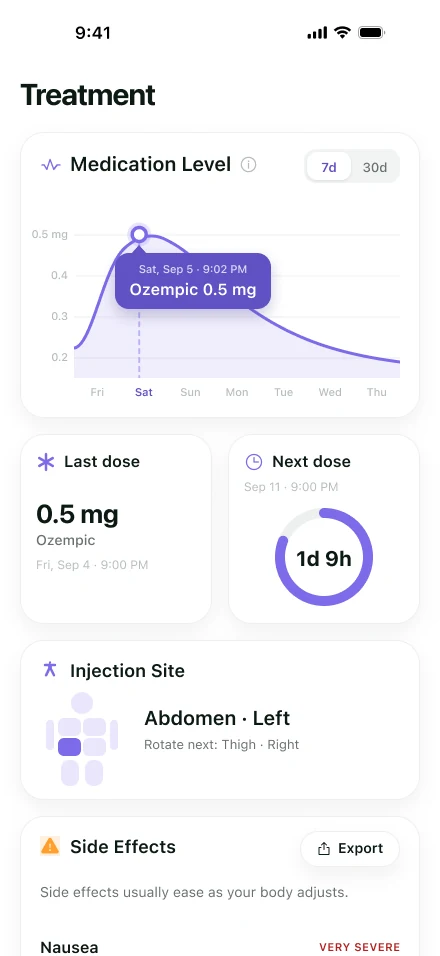
Medication level and next dose 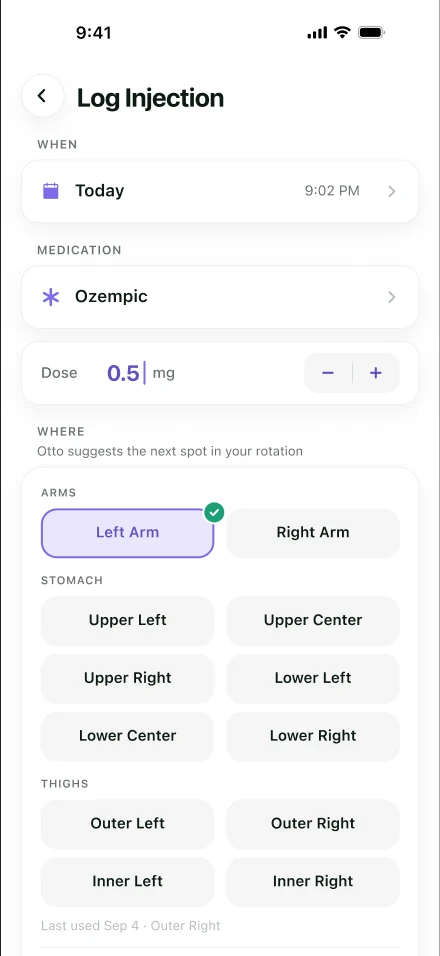
Otto suggests your next site 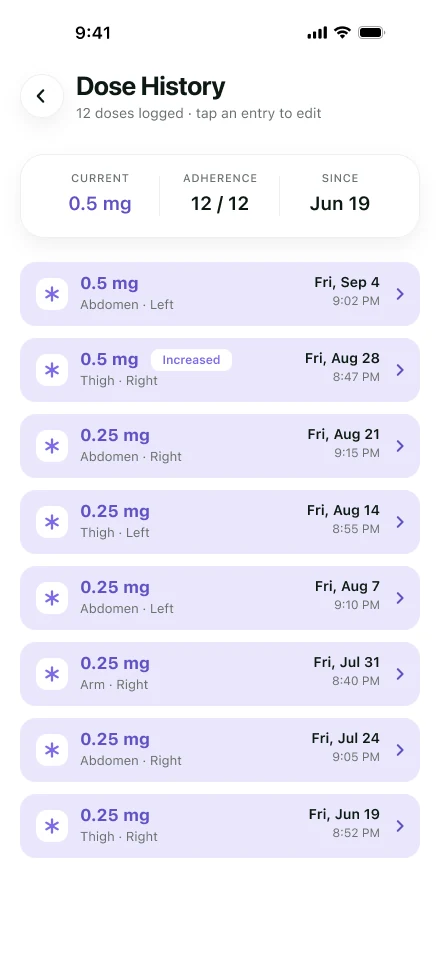
Every dose, every site
Frequently asked questions
Is Mounjaro the same as Zepbound?
Both contain tirzepatide and both are made by Lilly, but they carry different approvals. Mounjaro is approved for type 2 diabetes; Zepbound is approved for weight management and for obstructive sleep apnea in adults with obesity.
Can I change my Mounjaro shot day?
The label allows a new day as long as there are at least 3 days (72 hours) between two doses. If you are unsure how to make the switch, ask your pharmacist or prescriber.
Does Holt record my blood sugar?
Holt focuses on the medication side — shots, sites, meals, side effects, weight and water — and syncs with Apple Health. Keep your glucose readings in the meter or app your diabetes team asked you to use.
What if I take insulin or a sulfonylurea too?
The label notes a higher risk of low blood sugar when Mounjaro is combined with insulin or a sulfonylurea, and your prescriber may adjust those medicines. Logging any lows, with the time and what you ate, makes that conversation much easier.
Sources
- Mounjaro (tirzepatide) injection — Prescribing Information — U.S. Food and Drug Administration
Keep reading
- Mounjaro Side EffectsMounjaro side effects for people with type 2 diabetes — how common nausea and diarrhea were in trials, low blood sugar with insulin, eye checks and when to get help.
- Mounjaro vs OzempicMounjaro vs Ozempic for type 2 diabetes — what each is approved for, how the dose steps and pens differ, and what the SURPASS-2 head-to-head trial found for HbA1c.
- GLP-1 Injection SitesWhere to inject a GLP-1 like Wegovy or Zepbound, what the labels say about rotating sites, and a simple way to keep track of where you injected last.
- Moving Up a DoseWhy GLP-1 doses start low and step up every few weeks, what the Wegovy and Zepbound labels say about escalation, and what to note in the days after each step.