
Orforglipron Tracker — How the Non-Peptide GLP-1 Pill Works
How orforglipron works as a small-molecule, non-peptide oral GLP-1, what its 72-week trials found, and what's worth logging if you take it or join a study.
Worth remembering
- Orforglipron activates the same GLP-1 receptor as semaglutide, but it's a small molecule rather than a peptide.
- The label reports no clinically relevant food effect, so it's taken once daily with or without food.
- Its half-life is 29 to 49 hours and it reaches steady state in about a week, so each new dose takes a few days to settle.
- Trial papers describe capsule doses (6 to 36 mg); the approved tablets are labeled 0.8 to 17.2 mg, and the numbers aren't interchangeable.
- In the US, orforglipron's current label covers weight reduction only, not type 2 diabetes.
You've read the headlines: a GLP-1 pill with no fasting rules. Then you open a trial paper and the doses say 36 mg, while the bottle in your hand says 17.2 mg. Before you start logging anything, it helps to know what orforglipron actually is, and why its numbers look the way they do.
What makes orforglipron different from other GLP-1 medicines?
Most GLP-1 medicines, including semaglutide and tirzepatide, are peptides: chains of amino acids built to resemble the body's own hormones. Peptides are fragile in the gut, which is why most are injected, and why the semaglutide tablet needs an absorption enhancer called SNAC plus a strict empty-stomach routine.
Orforglipron is a small molecule, not a peptide. It binds to and activates the same human GLP-1 receptor, which the label describes as a regulator of appetite and food intake. But it's built more like a conventional pill.
One quirk follows from that. Orforglipron isn't active at the rat and mouse GLP-1 receptor, so the rodent thyroid tumors seen with other GLP-1 medicines couldn't be tested the same way. The label still carries the class's boxed thyroid warning.
Why can it be taken with food?
The label reports no clinically relevant food effect. In a study with an investigational tablet, taking it with food lowered total exposure by about 19%, which the label didn't consider meaningful. So the instructions are simply once daily, with or without food, swallowed whole.
That changes what's worth logging. With the semaglutide tablet, the clock around the tablet is part of the dose. With orforglipron, the main thing is that the tablet went down at all, each day.
How long does it stay in the body?
The label gives a half-life of 29 to 49 hours. Blood levels peak 4 to 8 hours after a dose and reach a steady state in about a week.
Two practical things follow. A new dose step takes several days to fully settle, so the first week of a step is a sensible window to watch closely. And because orforglipron is cleared mainly by the liver enzyme CYP3A4, other medicines can push its levels up or down. In one study, clarithromycin raised exposure about 3.5-fold and carbamazepine cut it by 82%. Your medicine list belongs in your log.
What did the trials find?
The label rests on two 72-week, placebo-controlled trials, both alongside diet and activity coaching. The first was published in the New England Journal of Medicine as ATTAIN-1.
| Average weight change at 72 weeks | Placebo | 5.5 mg | 9 mg | 17.2 mg |
|---|---|---|---|---|
| Adults without diabetes (3,127 people) | −2.1% | −7.4% | −8.3% | −11.1% |
| Adults with type 2 diabetes (1,613 people) | −2.5% | −5.1% | −7.0% | −9.6% |
In the diabetes trial, HbA1c fell by 1.7 points at 17.2 mg, versus 0.4 on placebo. The label also reports bigger falls in waist size, systolic blood pressure and triglycerides than on placebo. These are group averages; individual results ranged widely.
Is it approved for diabetes?
Not yet in the US label. The July 2026 label covers weight reduction in adults with obesity, or overweight plus a weight-related condition, sold as Foundayo. If you're in an orforglipron diabetes study, your study team's instructions come first. Our Foundayo tracker covers the day-to-day routine with the brand-name tablet.
What we'd track
Knowing how orforglipron behaves points to a slightly different log:
- Each daily tablet, and its strength as printed. Tablet strengths and trial capsule doses don't line up, so record exactly what's on the label.
- The date of every step. Steady state takes about a week, so it helps to see side effects against the start of each step.
- New or stopped medicines. CYP3A4 interactions can change your orforglipron levels; note any change and tell your prescriber.
- Stomach symptoms, rated daily. The label says nausea, vomiting and diarrhea were most common while doses were going up.
- Weight and waist, weekly. Trials measured both, and a weekly trend is calmer than a daily one.
Holt logs daily pills as well as weekly shots, with reminders, a lock-screen Live Activity, side-effect sliders lined up against your dose history, and Apple Health sync for weigh-ins. It's free to download, with an optional subscription.
Log orforglipron doses and steps in HoltSee it in Holt
Real screens from the app — the same places you’ll log, review and share.
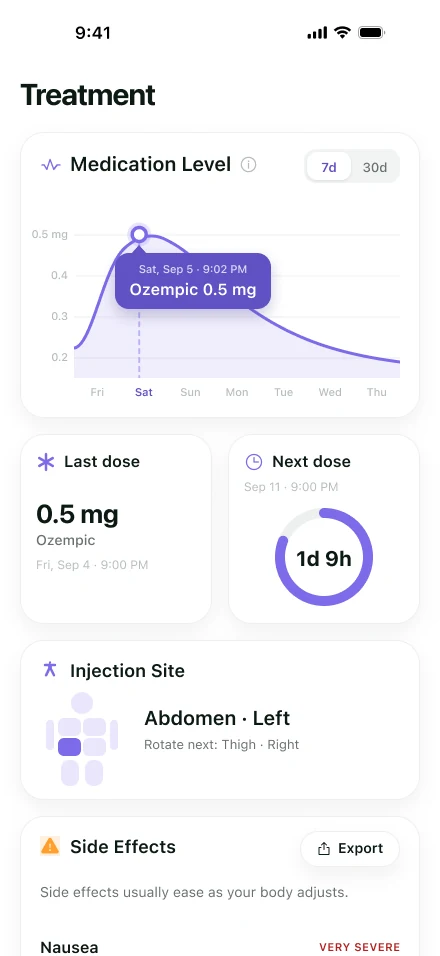
Medication level and next dose 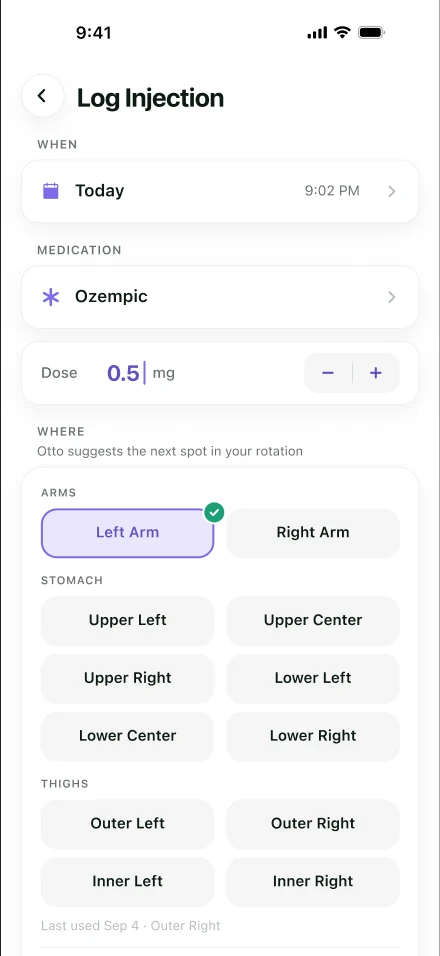
Otto suggests your next site 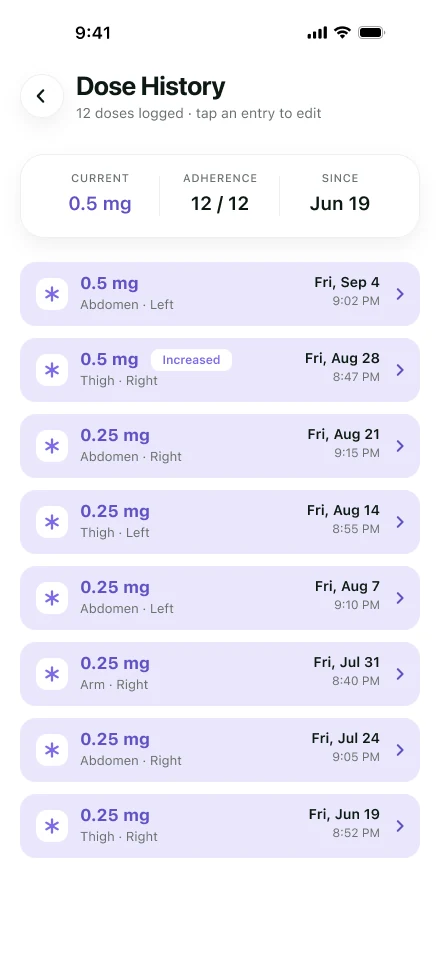
Every dose, every site
Frequently asked questions
Is orforglipron a peptide like semaglutide?
No. Semaglutide is a peptide, a chain of amino acids similar to the body's own GLP-1. Orforglipron is a small, non-peptide molecule that activates the same GLP-1 receptor.
Why doesn't orforglipron need an empty stomach?
The label reports no clinically relevant food effect on how much orforglipron reaches the blood. The semaglutide tablet relies on an absorption enhancer called SNAC and has strict empty-stomach rules.
Why do trial doses say 36 mg but my tablet says 17.2 mg?
Lilly says the trials used a capsule formulation and the approved product is a tablet. The 36 mg capsule matches the 17.2 mg tablet for blood levels, so the numbers can't be compared milligram for milligram.
Is orforglipron approved for type 2 diabetes?
Not in the US label as of its July 2026 revision, which covers weight reduction in adults. One of its trials enrolled adults with type 2 diabetes, and Lilly has studied it for diabetes separately.
Sources
- FOUNDAYO (orforglipron) tablets — Prescribing Information (revised 7/2026) — U.S. National Library of Medicine (DailyMed)
- Orforglipron, an Oral Small-Molecule GLP-1 Receptor Agonist for Obesity Treatment (ATTAIN-1) — New England Journal of Medicine
- Why are the approved doses of Foundayo different from the doses studied in clinical trials? — Eli Lilly and Company (Lilly Medical)
- WEGOVY (semaglutide) injection and tablets — Prescribing Information — U.S. National Library of Medicine (DailyMed)
Keep reading
- Foundayo TrackerTrack Foundayo, Lilly's once-daily orforglipron tablet — any time of day, with or without food, 30-day dose steps and the missed-dose rule, in plain words.
- Orforglipron Side EffectsOrforglipron side effects from its 72-week trials — how rates rose with dose, what differed with type 2 diabetes, lab changes and drug interactions.
- Foundayo vs TirzepatideFoundayo (orforglipron) vs tirzepatide (Mounjaro, Zepbound) — how the molecules work, trial results with type 2 diabetes, and what ATTAIN-MAINTAIN found.
- Semaglutide TrackerHow to track semaglutide whether it comes as a weekly pen, a daily tablet or a compounded vial — what each one's rules ask you to log, and why units aren't mg.