
GLP-1 After Pregnancy — What Labels Say About Breastfeeding
Thinking about a GLP-1 after having a baby? What the labels say about pregnancy, breastfeeding and birth control, and what small milk studies found.
Worth remembering
- Wegovy and Zepbound labels say stop when a pregnancy is recognized; semaglutide labels say stop 2 months before a planned one.
- The Wegovy label says breastfeeding isn't recommended with Wegovy tablets.
- Small studies found little or no semaglutide or tirzepatide in milk, but there's no data on effects in breastfed babies or on milk production.
- Tirzepatide labels say oral birth control pills may work less well for 4 weeks after starting and after each dose step.
- Smaller appetites matter more when you're recovering and possibly feeding a baby.
The baby is four months old. You're sleeping in pieces, your body feels like someone else's, and a friend mentions she started a GLP-1 after her second. You're curious — and immediately cautious, because you're still breastfeeding, or thinking about another baby in a year or two, or both.
That caution is well placed. Here's what the labels and studies actually say, and where the gaps are.
What do the labels say about pregnancy?
The weight-management labels are clear that these medicines aren't for pregnancy.
- Wegovy: weight loss offers no benefit during pregnancy and may cause fetal harm. Stop Wegovy used for weight reduction when a pregnancy is recognized, and stop at least 2 months before a planned pregnancy, because semaglutide stays in the body a long time.
- Ozempic: stop at least 2 months before a planned pregnancy, for the same reason.
- Zepbound: weight loss offers no benefit during pregnancy and may cause fetal harm; stop when a pregnancy is recognized. The label notes a pregnancy exposure registry.
If another pregnancy is in your plans, even loosely, that 2-month window is worth knowing before you start, not after.
What do the labels say about breastfeeding?
This is where the honest answer is "not enough is known."
| Medicine | What the label says |
|---|---|
| Wegovy tablets | Breastfeeding is not recommended. Semaglutide was below detectable levels in a milk study, but the absorption enhancer SNAC was found in milk and may build up in infants. |
| Wegovy injection | No data on semaglutide in human milk, on breastfed infants, or on milk production. |
| Ozempic | No data on semaglutide in human milk, on breastfed infants, or on milk production. |
| Zepbound and Mounjaro | In a single-dose study of 11 lactating women, tirzepatide was undetectable in 164 of 171 milk samples. No data on effects in breastfed infants or on milk production. |
The injection labels all ask clinicians to weigh the benefits of breastfeeding against the mother's need for the medicine and any potential effects on the baby.
What have milk studies found so far?
Two small studies are worth knowing about, mostly so you can recognize them when they come up.
A 2024 study in Nutrients tested milk from eight women using semaglutide injections, collected 0, 12 and 24 hours after a dose. No semaglutide was detected. The authors said questions about long-term infant outcomes, the mother's nutrient intake and the nutrient content of milk remain open.
The tirzepatide study is the one now summarized in the Zepbound and Mounjaro labels: one 5 mg dose, 11 healthy women, 28 days of sampling, with the drug detected in only 7 samples.
These are small, short studies. The NIH's LactMed database collects published research on medicines during breastfeeding and is updated as new studies appear, so it's a good place for your clinician to check the latest.
What about birth control after the baby?
Many people use a pill after giving birth, whether or not they're breastfeeding. The tirzepatide labels say tirzepatide may make oral hormonal contraceptives less effective, especially after the first dose. They advise switching to a non-oral method, or adding a barrier method, for 4 weeks after starting and for 4 weeks after each dose increase.
Given the semaglutide labels' 2-month pregnancy window, reliable contraception matters on either medicine. Your clinician can help pick a method that fits.
Why does appetite matter more right now?
Recovery from birth, broken sleep and, if you're breastfeeding, feeding a baby all ask a lot of your body. GLP-1s lower appetite, and the Nutrients authors flagged the mother's nutrient intake as an open question. If you and your clinician decide on a GLP-1, protein, fluids and regular meals deserve more attention, not less.
What we'd track
- Start date and every dose step. For the contraception window and, later, any pregnancy planning.
- Meals, protein and water. Low appetite plus a new baby is an easy way to under-eat.
- Side effects with severity. Nausea, fatigue and constipation, so you can tell what's the medicine and what's the 3 a.m. feeds.
- Weight trend, gently. Weekly at most, and without pressure.
- Questions for your clinician and pediatrician. Write them as they come.
Holt keeps doses, meals with protein estimates, water and side effects on one timeline. Shot reminders and home-screen widgets for water and nutrition help on days when nothing else goes to plan.
Keep postpartum notes in HoltIf your clinician wants the full picture, the doctor-visit report gathers it on one page. It's one less thing to remember in a season with plenty already.
See it in Holt
Real screens from the app — the same places you’ll log, review and share.
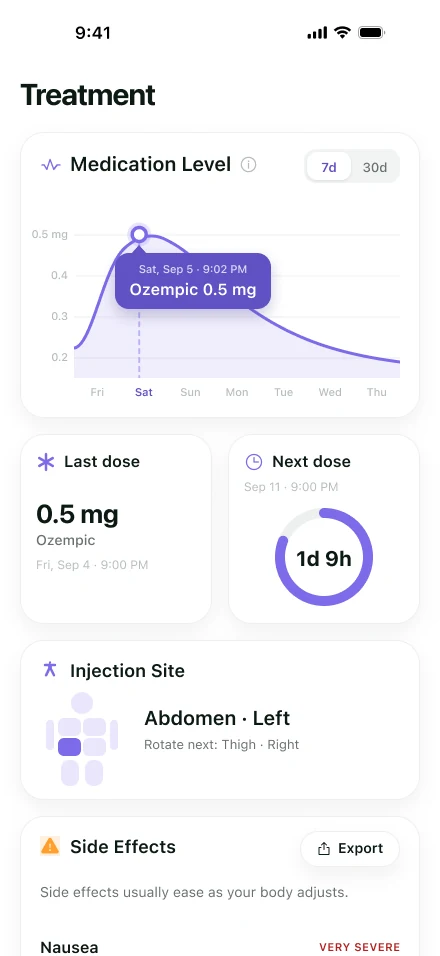
Medication level and next dose 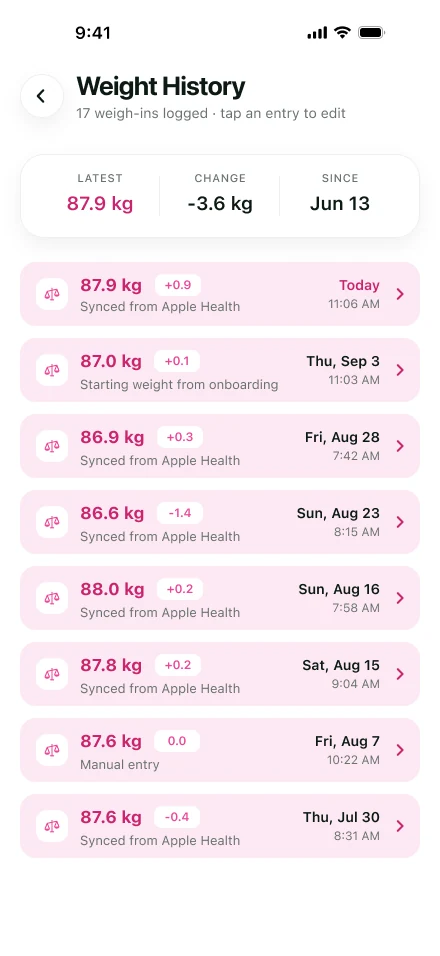
Weight history 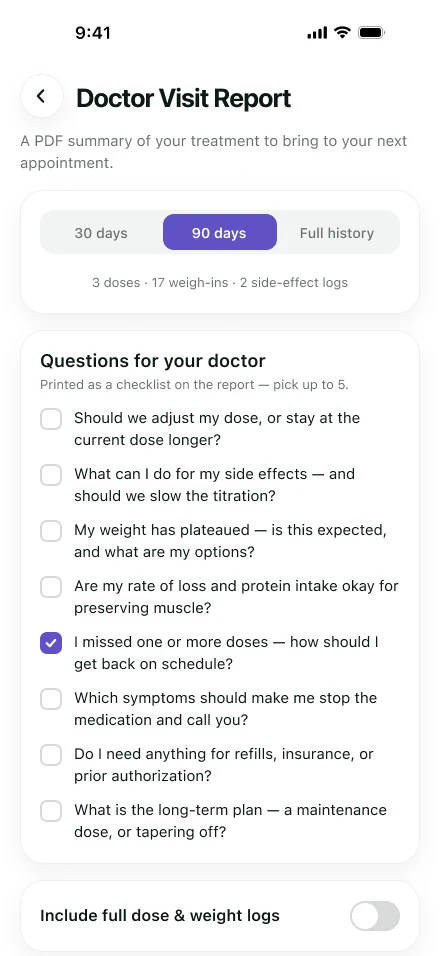
A report for your next appointment
Frequently asked questions
Is it safe to take a GLP-1 while breastfeeding?
That hasn't been shown. The labels say there are no data on effects in breastfed babies or on milk production, and the Wegovy label says breastfeeding isn't recommended with Wegovy tablets. Talk to your clinician and your baby's pediatrician before deciding.
How soon after giving birth can I start a GLP-1?
The labels don't give a postpartum start date. Your clinician will weigh your recovery, whether you're breastfeeding, and your plans for another pregnancy.
Can a GLP-1 affect my milk supply?
No one knows yet. The tirzepatide and semaglutide labels both say there's no data on effects on milk production.
Does a GLP-1 interfere with the mini-pill?
The tirzepatide labels say oral hormonal contraceptives may be less effective for 4 weeks after starting and after each dose increase, and advise a non-oral or added barrier method. Ask your clinician what applies to your method.
Sources
- Wegovy (semaglutide) injection and tablets — Prescribing Information — U.S. Food and Drug Administration
- Ozempic (semaglutide) injection — Prescribing Information — U.S. Food and Drug Administration
- Zepbound (tirzepatide) injection — Prescribing Information — U.S. Food and Drug Administration
- Mounjaro (tirzepatide) injection — Prescribing Information — U.S. Food and Drug Administration
- Subcutaneous Semaglutide during Breastfeeding: Infant Safety Regarding Drug Transfer into Human Milk (Diab et al.) — Nutrients, 2024
- Drugs and Lactation Database (LactMed) — Semaglutide — NICHD, National Library of Medicine
- Drugs and Lactation Database (LactMed) — Tirzepatide — NICHD, National Library of Medicine
Keep reading
- GLP-1 for PCOSGLP-1 medications aren't approved to treat PCOS. Here's what trials and guidelines say about weight and metabolic effects, what's still unknown, and what to track.
- GLP-1 and PerimenopauseStarting a GLP-1 while still having periods in your 40s? What the labels say about pregnancy and the pill, which bleeding to report, and how to tell symptoms apart.
- Wegovy Side EffectsWegovy side effects at the 2.4 mg maintenance dose — stomach symptoms, fatigue, hair loss, skin sensations, gallbladder and heart rate — from the FDA label.
- Zepbound Side EffectsZepbound side effects from the weight-management and sleep apnea trials — how often nausea, hair loss and fatigue came up, what eases with time and when to get help.