
Zepbound Tracker — Pens, Vials, Doses and Sleep Apnea Notes
Track weekly Zepbound shots for weight management or sleep apnea — which pen or vial you use, dose steps, storage days and side effects, in one calm iPhone log.
Worth remembering
- Zepbound is approved for long-term weight management and for moderate to severe obstructive sleep apnea in adults with obesity.
- Maintenance doses differ by reason for use — your prescriber picks yours.
- Single-dose pens and vials, multi-dose vials and KwikPens all exist, and each has its own storage clock.
- A missed dose can be taken within 4 days; after that, the label says skip it.
- Logging the form you use matters, because a switch means new training and new storage rules.
Your first box of Zepbound arrives and it is not what you pictured. Maybe it is a small glass vial with a syringe instead of a pen, or a KwikPen that holds four weeks of doses. Either way, there is a new routine to learn, a storage rule to remember and a week-by-week schedule to keep straight.
What is Zepbound approved for?
Zepbound is tirzepatide, a once-weekly injection used together with a reduced-calorie diet and more physical activity. The label lists two uses in adults:
- reducing excess body weight and keeping it off long term, in adults with obesity, or with overweight plus at least one weight-related condition;
- treating moderate to severe obstructive sleep apnea (OSA) in adults with obesity.
The same medicine is sold as Mounjaro for type 2 diabetes. The two brands are not meant to be combined; the label says using Zepbound with any other tirzepatide product or GLP-1 medicine is not recommended.
How do the doses climb?
Everyone begins at 2.5 mg once a week for 4 weeks. From there, the label increases the dose in 2.5 mg steps, with at least 4 weeks on each, until the maintenance dose is reached.
| Reason for use | Maintenance doses on the label | Maximum |
|---|---|---|
| Weight reduction and long-term maintenance | 5 mg, 10 mg or 15 mg weekly | 15 mg |
| Obstructive sleep apnea | 10 mg or 15 mg weekly | 15 mg |
The label asks prescribers to weigh how well the medicine is working and how well you tolerate it when choosing the maintenance dose. That is exactly the information a good log captures.
Pens, vials or KwikPen — which do I have?
Zepbound now comes in four forms, all in the same six strengths from 2.5 mg to 15 mg:
| Form | Doses inside | Storage limits on the label |
|---|---|---|
| Single-dose pen | 1 | Up to 21 days total, at or below 86°F (30°C) |
| Single-dose vial | 1 | Up to 21 days total, at or below 86°F (30°C) |
| Multi-dose vial | 4 | Discard after 30 days at room temperature, 30 days after first use, or after 4 doses |
| Single-patient-use KwikPen | 4 | Same 30-day / 4-dose rule |
With vials, the label says to use a syringe suitable for the dose and a new syringe and needle each time. It also says a KwikPen must never be shared between people, even with a new needle, and that it is not recommended for self-injection by people with visual impairment.
If your pharmacy switches your form, the label asks your care team to retrain you on the new one. That date is worth writing down.
What if my weekly shot slips?
The label allows a missed dose to be taken within 4 days (96 hours). If more than 4 days have passed, skip it and take the next one on your usual day. You can also move your shot day, as long as the two doses are at least 3 days (72 hours) apart.
Zepbound can be taken at any time of day, with or without food, in the abdomen or thigh — or the back of the upper arm if someone else injects. Rotate the site with each dose.
Is there anything different to note for sleep apnea?
In the label's two 52-week sleep apnea studies, people on Zepbound had larger average drops in the apnea-hypopnea index than people on placebo. Those are group averages, and they do not tell you what will happen for you.
The label is also careful about positive airway pressure: the studies did not test when, or whether, it is appropriate to stop using it. If you have OSA, your sleep notes — how rested you feel, whether you are using your machine — belong in your log next to the shots.
What we'd track
These are the things we would log on Zepbound, and why each one earns its place.
- Every shot, with dose, time and form. It settles missed-dose questions and shows when each step began.
- The date you opened a multi-dose vial or KwikPen. The 30-day clock starts there.
- Injection site. Rotation is on the label, and weekly memory is unreliable.
- Stomach symptoms and energy. Simple daily ratings show whether things settle after a dose step.
- Weight trend and, for OSA, sleep notes. A weekly trend is calmer than daily numbers, and sleep notes help your sleep doctor.
Holt reminds you on shot day with a Live Activity, logs site and dose in a couple of taps, syncs weight with Apple Health and builds a report for your next appointment. It is free on iPhone, with an optional subscription.
Track your Zepbound routine with HoltSee it in Holt
Real screens from the app — the same places you’ll log, review and share.
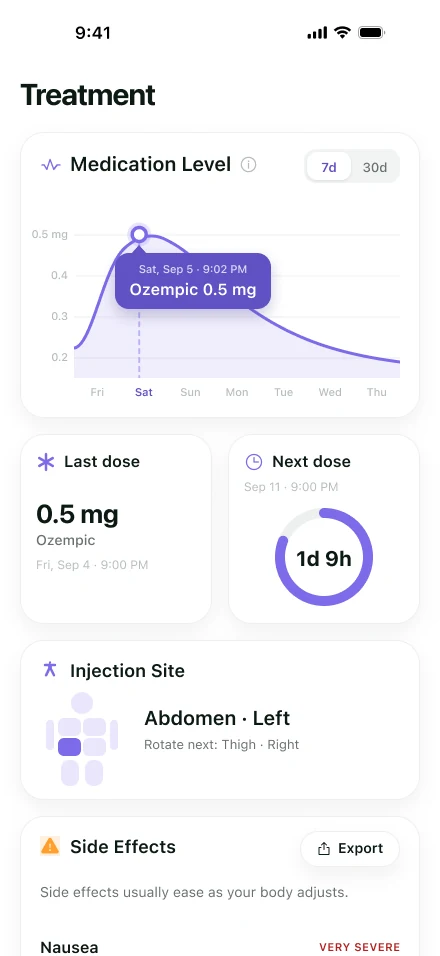
Medication level and next dose 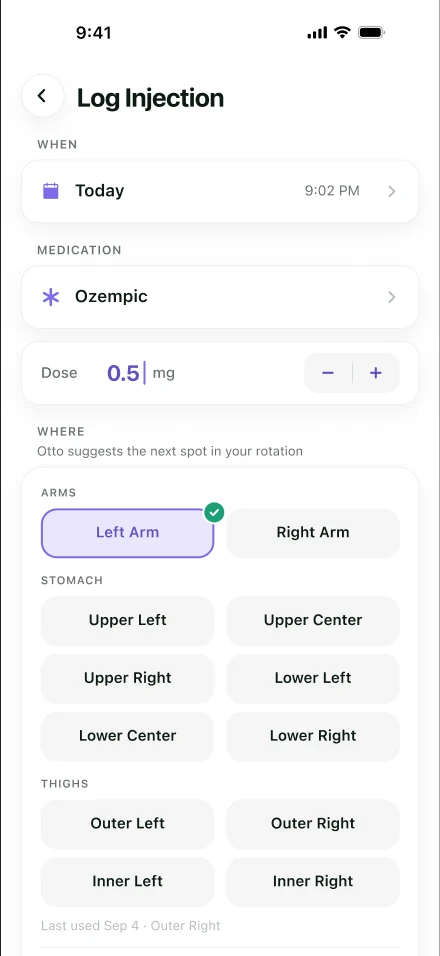
Otto suggests your next site 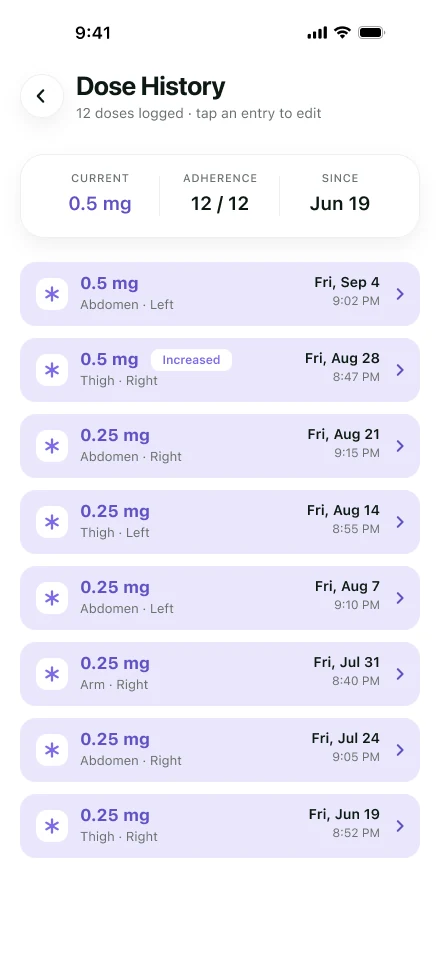
Every dose, every site
Frequently asked questions
Are Zepbound vials the same medicine as the pens?
Yes, the label lists the same tirzepatide strengths in single-dose pens and single-dose vials. With a vial you draw the dose with a syringe; the label says to use a new syringe and needle every time.
How long can Zepbound stay out of the fridge?
The label says a single-dose pen or vial can be kept unrefrigerated, at no more than 86°F (30°C), for up to 21 days in total. Multi-dose vials and KwikPens follow a 30-day rule instead.
Does Zepbound replace my CPAP?
The label does not say that. Its sleep apnea studies note they did not evaluate when, or whether, stopping positive airway pressure is appropriate, so that is a question for your sleep doctor.
Can I use Zepbound with another GLP-1 medicine?
The label says using Zepbound with other tirzepatide products or any GLP-1 receptor agonist is not recommended. Tell your prescriber about every medicine you take.
Sources
- Zepbound (tirzepatide) injection — Prescribing Information — U.S. Food and Drug Administration
Keep reading
- Zepbound Side EffectsZepbound side effects from the weight-management and sleep apnea trials — how often nausea, hair loss and fatigue came up, what eases with time and when to get help.
- Wegovy vs ZepboundWegovy vs Zepbound for weight management — how their approvals, dose schedules, pens, vials and tablets differ, and what the SURMOUNT-5 head-to-head trial found.
- Tirzepatide TrackerHow to track tirzepatide, the dual GIP/GLP-1 medicine behind Mounjaro and Zepbound, and what to write down if your tirzepatide comes from a compounding pharmacy.
- GLP-1 Injection SitesWhere to inject a GLP-1 like Wegovy or Zepbound, what the labels say about rotating sites, and a simple way to keep track of where you injected last.