
Foundayo vs Tirzepatide — One Receptor or Two, Pill or Peptide
Foundayo (orforglipron) vs tirzepatide (Mounjaro, Zepbound) — how the molecules work, trial results with type 2 diabetes, and what ATTAIN-MAINTAIN found.
| Foundayo (orforglipron) | Tirzepatide | |
|---|---|---|
| Type of molecule | Small molecule, non-peptide | Peptide with a fatty-acid chain that extends its half-life |
| Receptors activated | GLP-1 | GIP and GLP-1 |
| Brands in the US | Foundayo | Mounjaro, Zepbound |
| Approved uses | Weight management in adults | Type 2 diabetes (Mounjaro); weight management and obstructive sleep apnea with obesity (Zepbound) |
| How it is taken | Tablet once daily, with or without food | Injection once weekly |
| Half-life | 29–49 hours | About 5–6 days |
| How it is cleared | Liver enzyme CYP3A4, so some medicines change its levels | Broken down like other proteins |
| Weight change at 72 weeks, adults with type 2 diabetes | −9.6% at 17.2 mg (placebo −2.5%) | −14.7% at 15 mg (placebo −3.2%) |
| HbA1c change in those trials | −1.7 at 17.2 mg (placebo −0.4) | −2.1 at 15 mg (placebo −0.5) |
Worth remembering
- Orforglipron acts on one receptor (GLP-1); tirzepatide acts on two (GIP and GLP-1).
- Orforglipron is a small molecule taken daily; tirzepatide is a peptide injected weekly.
- Tirzepatide is approved for type 2 diabetes as Mounjaro; Foundayo's US label covers weight reduction only.
- In separate 72-week trials in adults with type 2 diabetes, average weight change at the top dose was −9.6% on orforglipron and −14.7% on tirzepatide.
- In ATTAIN-MAINTAIN, orforglipron helped people who'd lost weight on tirzepatide keep most of it, though not all.
You've heard "tirzepatide" in a dozen conversations, and now "orforglipron" too. Both come from Lilly, both appear on weight-management prescriptions, and both are long words you'd rather not mix up. Under the brand names, the two molecules work differently. Here's what that means, and what the trials show.
How do the two molecules differ?
Tirzepatide is a peptide, a chain of amino acids modeled on the body's own gut hormones, with a fatty-acid chain attached that keeps it in the body for days. It activates two receptors, GIP and GLP-1. Its half-life is about 5 to 6 days, which is why it's injected once a week.
Orforglipron is a small molecule, not a peptide. It activates one receptor, GLP-1, the same target as semaglutide. Because it's built like a conventional pill, it can be swallowed, with or without food. Its half-life is 29 to 49 hours, which suits a once-daily tablet.
They're also cleared differently. Tirzepatide is broken down like other proteins. Orforglipron is cleared mainly by the liver enzyme CYP3A4, so some medicines can raise or lower its levels; the label limits the dose to 9 mg alongside strong CYP3A4 inhibitors.
Which brands and approvals go with each?
- Orforglipron is sold as Foundayo, approved by the FDA on April 1, 2026, for weight reduction in adults with obesity, or overweight plus a weight-related condition.
- Tirzepatide is sold as Mounjaro, for blood sugar control in adults with type 2 diabetes, and as Zepbound, for weight management and obstructive sleep apnea with obesity.
So if type 2 diabetes is the main reason for treatment, only tirzepatide currently has that approval in the US. For a brand-level, day-to-day comparison, see Foundayo vs Zepbound.
How do they compare with type 2 diabetes?
Both labels include a 72-week, placebo-controlled trial in adults with type 2 diabetes and overweight or obesity, with an average starting HbA1c of 8%:
- Orforglipron: weight change of −5.1%, −7.0% and −9.6% on 5.5, 9 and 17.2 mg, versus −2.5% on placebo. HbA1c fell by up to 1.7 points, versus 0.4.
- Tirzepatide (Zepbound label): weight change of −12.8% and −14.7% on 10 and 15 mg, versus −3.2% on placebo. HbA1c fell by 2.1 points, versus 0.5.
These were separate trials, run at different times in different people, so the figures aren't a direct comparison. They're the closest like-for-like populations the labels offer.
What happens if you switch from tirzepatide to orforglipron?
That's the question Lilly's ATTAIN-MAINTAIN trial asked, published in Nature Medicine in 2026. Adults who had lost weight on tirzepatide were randomly assigned to orforglipron or placebo for 52 weeks, with no option to stay on injections.
- On orforglipron, they kept an average of 74.7% of their earlier weight reduction.
- On placebo, they kept 49.2%.
- A separate group coming off semaglutide kept 79.3% on orforglipron, versus 37.6% on placebo.
So orforglipron held on to most of the earlier loss, but not all of it, and the trial didn't include anyone who simply stayed on tirzepatide. It was funded by Lilly, which makes both medicines. Any switch is a decision for you and your prescriber.
Do the side effects differ?
The stomach side effects are similar in kind: nausea, diarrhea, vomiting and constipation, mostly while doses are going up. Tirzepatide, being injected, adds injection-site reactions. Both labels carry a boxed warning about thyroid C-cell tumors and warnings about pancreatitis, gallbladder disease, kidney injury from dehydration and low blood sugar alongside insulin or a sulfonylurea. Neither label recommends taking them together.
What we'd track
Whichever molecule you're on, these are the notes we'd keep:
- Medicine, form and strength, as printed. Foundayo strengths and tirzepatide strengths look nothing alike.
- Every dose, daily or weekly. And the injection site, if you're on tirzepatide.
- Switch dates. The last old dose and the first new one, if your prescriber changes your treatment.
- Blood sugar notes, if you have type 2 diabetes, especially with insulin or a sulfonylurea.
- Weight trend and side effects. Weekly weight and daily side-effect ratings show how each step is going.
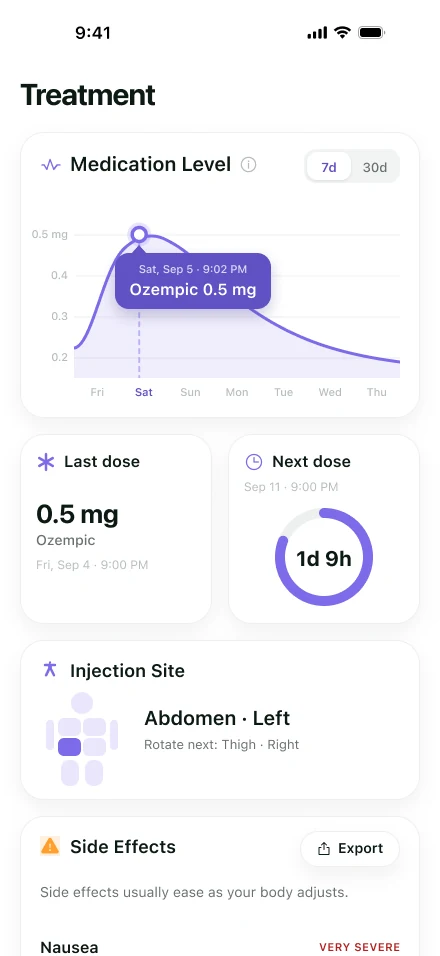
Holt handles both rhythms: daily pill reminders and weekly shot reminders, a lock-screen Live Activity, injection-site rotation, side effects against your dose history, and a doctor-visit report. It's free to download, with an optional subscription. This page is written by the Holt team.
Track orforglipron or tirzepatide in HoltSee it in Holt
Real screens from the app — the same places you’ll log, review and share.
Medication level and next dose 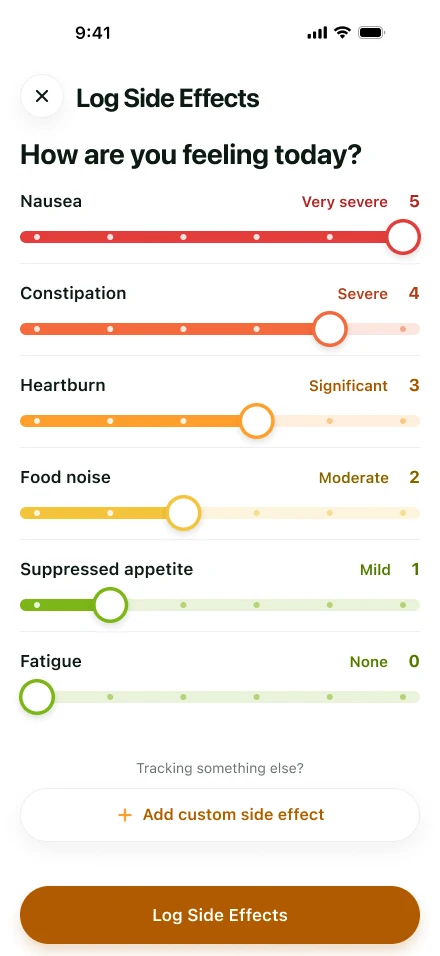
Side effects, by severity 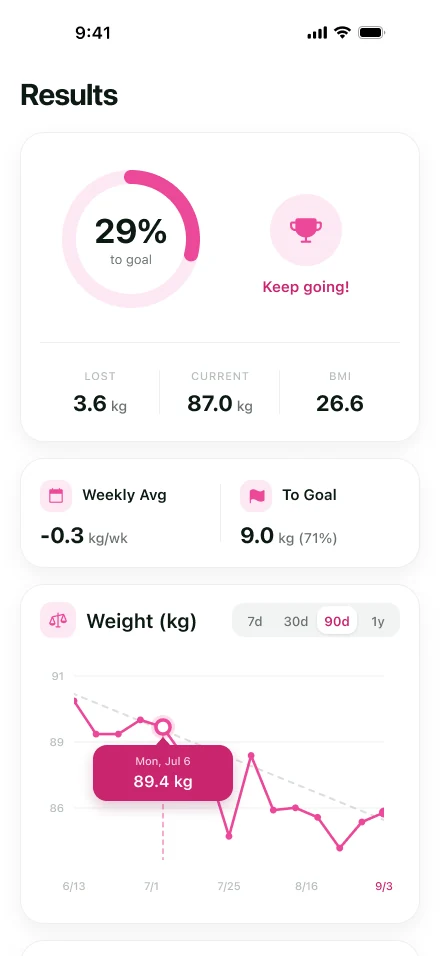
Progress toward your goal
Frequently asked questions
Is orforglipron stronger than tirzepatide?
They haven't been compared head to head. In their separate label trials, tirzepatide's top dose produced larger average weight changes than orforglipron's, but different trials can't be lined up exactly.
Can Foundayo replace Mounjaro for type 2 diabetes?
Not on its current US label. Foundayo is approved for weight reduction in adults; Mounjaro is approved to improve blood sugar control in adults with type 2 diabetes. Your prescriber decides what's right for you.
What did ATTAIN-MAINTAIN find?
Adults who'd lost weight on tirzepatide were randomly switched to orforglipron or placebo for 52 weeks. On orforglipron they kept an average of 74.7% of their earlier weight reduction, versus 49.2% on placebo.
Why is one a pill and the other a shot?
Tirzepatide is a peptide, which the gut would break down, so it's injected. Orforglipron is a small, non-peptide molecule that's absorbed from a swallowed tablet.
Sources
- FOUNDAYO (orforglipron) tablets — Prescribing Information (revised 7/2026) — U.S. National Library of Medicine (DailyMed)
- Zepbound (tirzepatide) injection — Prescribing Information — U.S. Food and Drug Administration
- Mounjaro (tirzepatide) injection — Prescribing Information — U.S. Food and Drug Administration
- Orforglipron for maintenance of body weight reduction — the phase 3b ATTAIN-MAINTAIN trial — Nature Medicine
Keep reading
- Foundayo vs ZepboundFoundayo vs Zepbound — how Lilly's daily orforglipron pill and weekly tirzepatide shot differ in approvals, routine, storage, side effects and label trial results.
- Tirzepatide TrackerHow to track tirzepatide, the dual GIP/GLP-1 medicine behind Mounjaro and Zepbound, and what to write down if your tirzepatide comes from a compounding pharmacy.
- Orforglipron TrackerHow orforglipron works as a small-molecule, non-peptide oral GLP-1, what its 72-week trials found, and what's worth logging if you take it or join a study.
- Semaglutide vs TirzepatideSemaglutide vs tirzepatide — one hormone target or two, the brands behind each, and what the SURPASS-2 and SURMOUNT-5 head-to-head trials found.