
Retatrutide Tracker — A Log for TRIUMPH Trial Participants
Retatrutide is still investigational. If you're in a TRIUMPH study, here's what's known so far about the weekly shot, its dose steps and what's worth logging.
Worth remembering
- Retatrutide isn't approved anywhere in the US; it's legally available only to clinical-trial participants.
- It's a once-weekly injection that acts on three receptors — GIP, GLP-1 and glucagon.
- In TRIUMPH-1, doses started at 2 mg and went up every 4 weeks to 4, 9 or 12 mg.
- The FDA has warned sellers offering "research" retatrutide online; those products aren't approved.
- Your study protocol and study team decide every dose — a personal log just keeps your own record straight.
The study nurse hands you a kit with a code on it instead of a brand name, and a visit calendar that stretches over a year and a half. You know you're on retatrutide, or possibly placebo, and that you'll inject once a week. What you'd like is a simple way to remember what happened between visits.
This page is for people in that position. Retatrutide isn't an approved treatment, and we won't treat it like one. Here's what's known so far, and how a personal log can help.
What is retatrutide, and is it approved?
Retatrutide is an investigational once-weekly injection made by Lilly. It's a single molecule that activates three hormone receptors: GIP, GLP-1 and glucagon. Tirzepatide (Mounjaro, Zepbound) acts on the first two; semaglutide acts on GLP-1 alone.
It isn't FDA approved. In July 2026, Lilly said it plans to submit retatrutide to the FDA in the first quarter of 2027. Until a decision is made, it's legally available only to people enrolled in clinical trials.
What are the TRIUMPH trials?
TRIUMPH is the name of Lilly's main phase 3 program for retatrutide. Results reported so far include:
- TRIUMPH-1 — 2,339 adults with obesity or overweight and without diabetes, over 80 weeks. Published in the New England Journal of Medicine in September 2026.
- TRIUMPH-2 — 1,152 adults with type 2 diabetes and obesity or overweight, over 80 weeks.
- TRIUMPH-3 — 1,949 adults with severe obesity and established heart disease, over 80 weeks.
- TRIUMPH-4 — adults with obesity or overweight and knee osteoarthritis.
Lilly is also studying retatrutide for sleep apnea, low back pain, heart and kidney outcomes and fatty liver disease. The TRIUMPH trials reported so far were double-blind and placebo-controlled, so participants didn't know which group they were in.
How were doses given in the trials?
In TRIUMPH-1, everyone started at 2 mg once weekly and went up every 4 weeks to a target of 4, 9 or 12 mg. Up to two permanent dose reductions were allowed. Other TRIUMPH trials used 9 and 12 mg, and some added 4 mg.
Your own schedule is set by your study's protocol, not by this summary. If anything about your kit, dose or timing is unclear, the study team is the right call.
What did the trials find so far?
In TRIUMPH-1, average weight change at 80 weeks was −17.6%, −23.7% and −25.0% on 4, 9 and 12 mg, versus −3.9% on placebo, counting everyone regardless of whether they stayed on treatment. In TRIUMPH-2 and TRIUMPH-3, Lilly reported averages of up to −20.8% and −22.6%.
Those are group averages from studies that are still being analyzed and reviewed. The most common side effects were stomach-related. The trials also reported unusual skin sensations, called dysesthesia, more often than with placebo. Our retatrutide side effects page covers the numbers.
What we'd track
Your study keeps the official record. These are the personal notes that make your visits easier:
- Each weekly shot, with the day and time. If a shot slips, you'll know exactly how late it was when the team asks.
- Injection site. Rotating sites and noting any redness or itching helps; injection-site reactions were reported in the trials.
- Side effects between visits. Nausea, constipation, diarrhea and any odd skin sensations, rated daily, with the date each began.
- Dizziness or light-headedness. Low blood pressure was reported more often on retatrutide than placebo in TRIUMPH-1.
- Visit dates and dose changes. So your log lines up with the study's calendar.
Holt logs weekly shots with reminders and a lock-screen Live Activity, tracks injection sites with a suggested next spot in your rotation, and lines up side-effect sliders against your dose days. It's free to download, with an optional subscription. Your study team's instructions always come first.
Keep a personal weekly shot log in HoltSee it in Holt
Real screens from the app — the same places you’ll log, review and share.
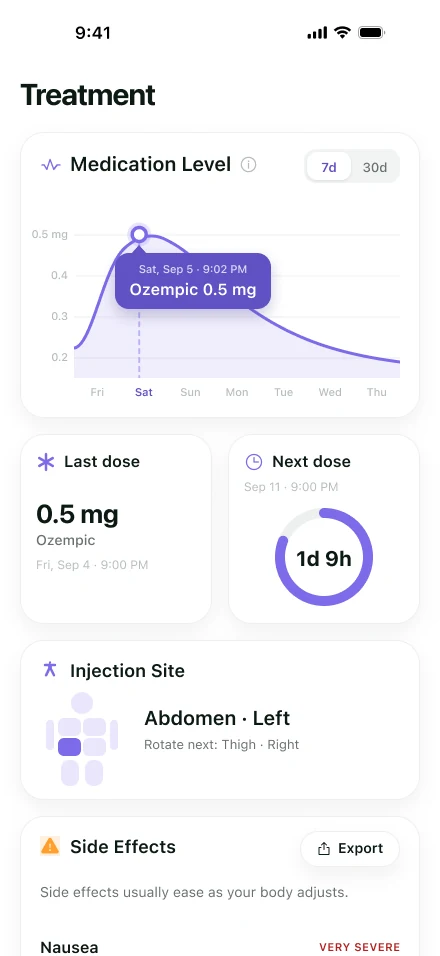
Medication level and next dose 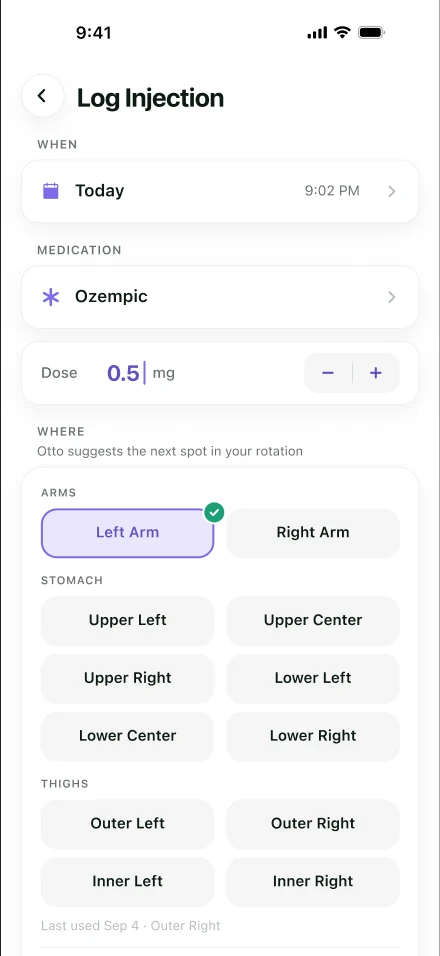
Otto suggests your next site 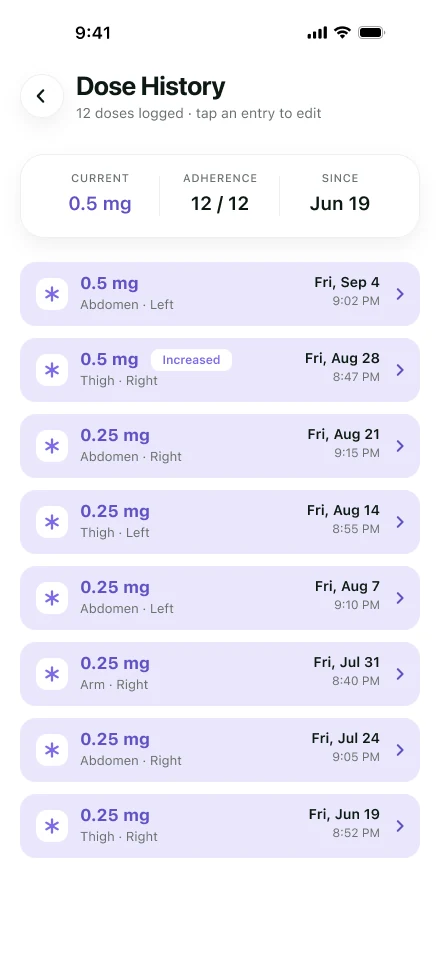
Every dose, every site
Frequently asked questions
Is retatrutide FDA approved?
No. As of November 2026 it's investigational. Lilly has said it plans to submit retatrutide to the FDA in the first quarter of 2027.
Can I get retatrutide outside a trial?
Not legally. Lilly says the molecule can't be sold or marketed for human use, and the FDA has issued warning letters to websites selling retatrutide labeled "for research purposes".
How is retatrutide different from tirzepatide?
Tirzepatide acts on GIP and GLP-1 receptors. Retatrutide also acts on the glucagon receptor, which is why it's often called a triple agonist.
Should I log my trial doses even if the study keeps records?
The study keeps the official record. A personal log of how you feel between visits, and which site you used, makes it easier to answer the team's questions accurately.
Sources
- Retatrutide, a Triple Hormone Receptor Agonist, for Treatment of Obesity (TRIUMPH-1) — New England Journal of Medicine
- What are the preliminary results of retatrutide from TRIUMPH-1? — Eli Lilly and Company (Lilly Medical)
- Lilly's triple agonist, retatrutide, successful in two additional Phase 3 obesity trials (July 23, 2026) — Eli Lilly and Company
- FDA's concerns with unapproved GLP-1 drugs used for weight loss — U.S. Food and Drug Administration
Keep reading
- Retatrutide Side EffectsRetatrutide is investigational. What its TRIUMPH trials reported so far on nausea, skin sensations, blood pressure and stopping treatment, for trial participants.
- Tirzepatide TrackerHow to track tirzepatide, the dual GIP/GLP-1 medicine behind Mounjaro and Zepbound, and what to write down if your tirzepatide comes from a compounding pharmacy.
- GLP-1 Injection SitesWhere to inject a GLP-1 like Wegovy or Zepbound, what the labels say about rotating sites, and a simple way to keep track of where you injected last.
- Moving Up a DoseWhy GLP-1 doses start low and step up every few weeks, what the Wegovy and Zepbound labels say about escalation, and what to note in the days after each step.