
Retatrutide Side Effects — What the TRIUMPH Trials Reported
Retatrutide is investigational. What its TRIUMPH trials reported so far on nausea, skin sensations, blood pressure and stopping treatment, for trial participants.
Worth remembering
- Retatrutide is investigational; side-effect data comes from trials, not an approved label.
- In TRIUMPH-1, nausea affected 28.6% to 42.4% on retatrutide, versus 14.8% on placebo.
- Dysesthesia, a burning or altered skin sensation, affected about 5% to 13% in TRIUMPH-1, versus 0.9% on placebo.
- Low blood pressure was reported in up to 8.8% at 12 mg, versus 0.9% on placebo.
- Your study team is the first call for any side effect you notice during a trial.
Your study visit is next Thursday. Since the last one, there's been a week of queasy afternoons, and now a strange prickling across your back that you can't quite describe. You want to know whether this is something the trials have seen before, and how to explain it clearly when the study nurse asks. Here's what's been reported so far.
Why isn't there an official list yet?
Because retatrutide isn't approved. Approved medicines have an FDA label that sets out side effects from all their trials. Retatrutide is investigational, and Lilly plans to submit it to the FDA in the first quarter of 2027.
What we have instead is trial data: TRIUMPH-1, published in the New England Journal of Medicine, plus results Lilly has reported for TRIUMPH-2, -3 and -4. That data may still be refined, and it's not a substitute for what your study team tells you.
What were the most common side effects?
TRIUMPH-1 enrolled 2,339 adults with obesity or overweight and without diabetes, for 80 weeks. Doses started at 2 mg weekly and rose every 4 weeks. Lilly reports these rates:
| Side effect | Placebo | 4 mg | 9 mg | 12 mg |
|---|---|---|---|---|
| Nausea | 14.8% | 28.6% | 38.4% | 42.4% |
| Diarrhea | 13.5% | 25.2% | 34.1% | 32.0% |
| Constipation | 10.9% | 23.8% | 25.9% | 26.1% |
| Vomiting | 4.8% | 10.6% | 22.8% | 25.3% |
| Dysesthesia | 0.9% | 5.1% | 12.3% | 12.5% |
| Injection-site reactions | 3.8% | 5.5% | 8.9% | 12.2% |
| Low blood pressure | 0.9% | 2.7% | 5.3% | 8.8% |
Urinary tract infections were also more common, at 7.5% to 8.7% on retatrutide versus 5.3% on placebo. Stopping the study drug because of side effects happened in 4.1%, 6.5% and 11.2% on the three doses, versus 4.6% on placebo.
What is dysesthesia?
It's an altered skin sensation. Lilly describes it as a skin burning sensation and related events, mostly mild to moderate. It was clearly dose-related in TRIUMPH-1, and in TRIUMPH-4, a trial in people with knee osteoarthritis, it was reported in 9% on 9 mg and 21% on 12 mg, versus 1% on placebo.
Dysesthesia also appears on the label of high-dose semaglutide, so it isn't unique to retatrutide. If you notice it, note where on your body it is, when it started, and whether it's linked to shot day.
Were the other TRIUMPH trials similar?
Broadly, yes. In TRIUMPH-2, in adults with type 2 diabetes, Lilly reported nausea in 13.7% to 28.0% and diarrhea in 27.4% to 33.6% on retatrutide, with dysesthesia in 4.5% to 7.3%. In TRIUMPH-3, in adults with severe obesity and heart disease, 9.8% and 13.5% stopped because of side effects on 9 and 12 mg, versus 4.8% on placebo.
What about serious events?
In TRIUMPH-1, serious adverse events were reported in 7.7% to 10.5% on retatrutide versus 5.5% on placebo. Adjudicated pancreatitis was uncommon, at 0.2% to 0.7% versus 0.3%. Lilly also reported one case each of thyroid cancer or C-cell hyperplasia on 4 mg and 12 mg, and three liver-related events on 12 mg.
Numbers this small can't show cause and effect on their own. They're the kind of thing regulators will look at closely, and the reason trials monitor participants carefully.
What we'd track
If you're in a retatrutide trial, these are the notes we'd keep between visits:
- A daily stomach rating. Nausea, diarrhea, constipation and vomiting rose with dose in TRIUMPH-1.
- Skin sensations, with location and date. Dysesthesia is one of the side effects trials are watching closely.
- Dizziness or fainting. Low blood pressure was reported more often on retatrutide.
- Injection site and any reaction. Redness or itching, so you can see whether one spot is the problem.
- Water. Fluid loss from vomiting or diarrhea is a common thread in GLP-1 class warnings.
Holt lets you log side effects with severity sliders and add custom ones, like a skin sensation, lined up against your weekly shot days and injection sites. Its doctor-visit report turns weeks of notes into a summary you can bring to a study visit. It's free to download, with an optional subscription.
Keep a side-effect log for your trial in HoltSee it in Holt
Real screens from the app — the same places you’ll log, review and share.
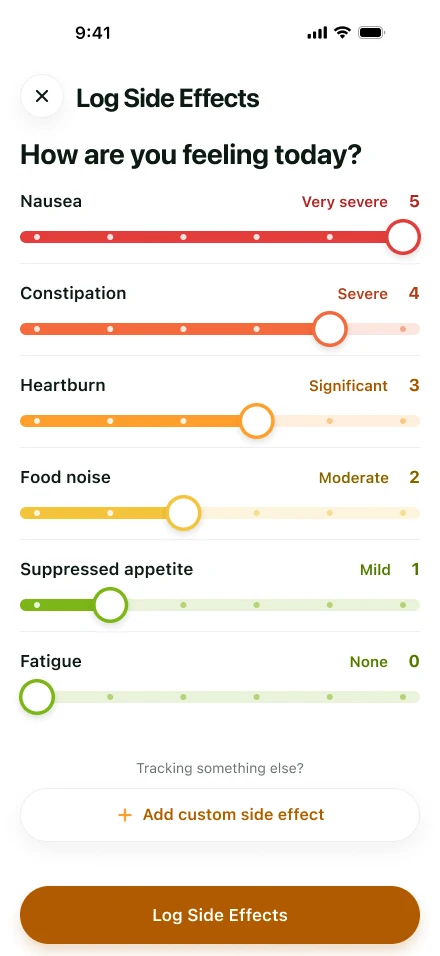
Side effects, by severity 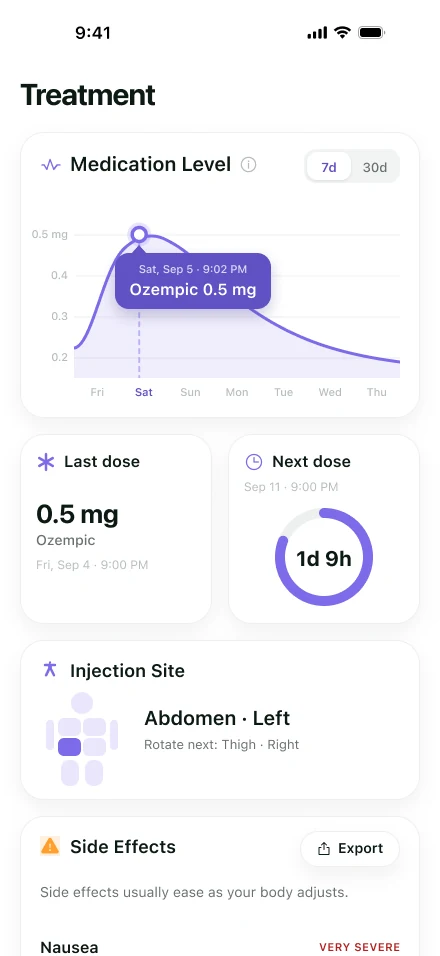
Medication level and next dose 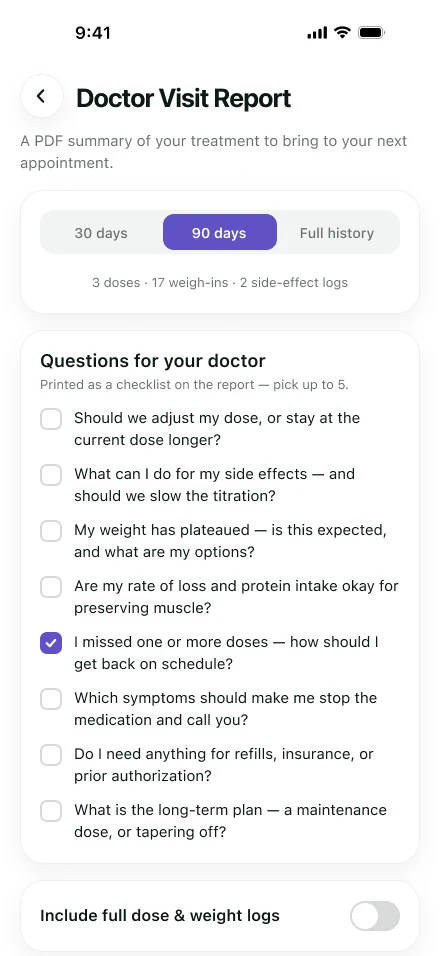
A report for your next appointment
Frequently asked questions
What is the most common side effect of retatrutide?
Nausea, in TRIUMPH-1. It was reported by 28.6%, 38.4% and 42.4% of people on 4, 9 and 12 mg, versus 14.8% on placebo.
What is dysesthesia on retatrutide?
Lilly describes it as a skin burning sensation and related events. In TRIUMPH-1 it was mostly mild to moderate and more common on 9 and 12 mg than on 4 mg.
How many people stopped retatrutide because of side effects?
In TRIUMPH-1, 4.1%, 6.5% and 11.2% stopped the study drug on 4, 9 and 12 mg, versus 4.6% on placebo. Rates in TRIUMPH-3 were 9.8% and 13.5% on 9 and 12 mg, versus 4.8%.
Will there be an official side-effect list?
If retatrutide is approved, its FDA label will set out the official list. Lilly has said it plans to submit it to the FDA in the first quarter of 2027.
Sources
- What are the preliminary results of retatrutide from TRIUMPH-1? — Eli Lilly and Company (Lilly Medical)
- Retatrutide, a Triple Hormone Receptor Agonist, for Treatment of Obesity (TRIUMPH-1) — New England Journal of Medicine
- Was dysesthesia reported as an adverse event in the retatrutide TRIUMPH trials? — Eli Lilly and Company (Lilly Medical)
- Lilly's triple agonist, retatrutide, successful in two additional Phase 3 obesity trials (July 23, 2026) — Eli Lilly and Company
Keep reading
- Retatrutide TrackerRetatrutide is still investigational. If you're in a TRIUMPH study, here's what's known so far about the weekly shot, its dose steps and what's worth logging.
- Tirzepatide Side EffectsTirzepatide side effects across Mounjaro and Zepbound, how they compared with semaglutide head to head, and what the FDA says about compounded versions.
- GLP-1 Side EffectsThe most common GLP-1 side effects for semaglutide and tirzepatide, when they tend to appear, which warning signs need a doctor, and how tracking helps.