
Side effects
GLP-1 Hair Loss — What the Labels Say and Why It Happens
Hair loss on Ozempic, Wegovy or Zepbound? What the FDA labels report, why rapid weight loss can trigger shedding, and when it's worth seeing a doctor.
You're four months in, the scale has finally been moving, and then one morning the shower drain looks wrong. There's more hair on your brush, more on your pillow, and a ponytail that feels thinner in your hand. It's an unsettling thing to notice right when everything else seems to be going well. It's also more expected than most people are told.
Is hair loss a real GLP-1 side effect?
Yes, and it's on the labels. The Wegovy and Zepbound prescribing information both list hair loss among the side effects seen more often than with placebo in their weight-management trials.
| Medication (label) | Hair loss on medication | On placebo |
|---|---|---|
| Wegovy 2.4 mg injection | 3% | 1% |
| Wegovy 7.2 mg injection (its own trials) | 6% | 1% |
| Zepbound 5 mg / 10 mg / 15 mg | 5% / 4% / 5% | 1% |
These come from different trials with different people, so they aren't a head-to-head comparison. For Ozempic and Mounjaro, which are approved for type 2 diabetes, the labels list alopecia among reactions reported after approval. Those reports are voluntary, so the labels don't give a rate.
Our GLP-1 side effects overview and the brand pages for Wegovy and Zepbound put this alongside everything else the labels list.
Why does it seem to affect women more?
Both labels show a clear gap. In pooled Zepbound trials, hair loss was reported by 7.1% of women versus 0.5% of men, compared with 1.3% and 0% on placebo. In pooled Wegovy 2.4 mg trials it was 4% of women and 0.9% of men, against 2% and 0% on placebo. In the Wegovy 7.2 mg trials, 8.4% of women reported it, against 0.2% of men.
The labels don't explain why. We won't guess either.
Is it the medication or the weight loss?
The labels point to the weight loss. Both Wegovy and Zepbound say hair loss in their trials "was associated with weight reduction."
That fits what dermatologists already know. The American Academy of Dermatology (AAD) says it's normal to shed 50 to 100 hairs a day. When the body sheds significantly more, the medical term is telogen effluvium, and the AAD lists losing 20 pounds or more among the common triggers, along with things like giving birth, high fever or surgery.
The timing is what catches people out. The AAD says most people notice the extra shedding a few months after the stressful event. That's why it can show up well after your first dose, when the weight loss is well under way.
Will it grow back?
For telogen effluvium in general, the AAD's description is reassuring: the shedding is usually temporary, it stops as your body readjusts, and hair tends to regain its normal fullness within six to nine months. It also notes that if the stressor continues, shedding can last longer.
What the GLP-1 labels don't give is a recovery timeline for people on these medications. In the Zepbound trials, no one on Zepbound stopped treatment because of hair loss. Your own experience may differ, which is why it's worth keeping notes.
Does what I eat make a difference?
It can matter. The 2025 joint nutrition advisory from four US obesity and nutrition societies warns that large, rapid drops in food intake can leave people short on essential vitamins and minerals, especially at very low calorie intakes. It names iron, zinc, magnesium, calcium and several vitamins among the nutrients of concern, and lists excessive hair loss among the signs of a real deficiency, alongside unusual fatigue, flaky or itchy skin, muscle weakness, poor wound healing and easy bruising.
On protein, the advisory notes that higher targets of 1.2–1.6 g per kg of body weight a day have been proposed during active weight loss, while saying it's unclear which body weight that should be based on. Our protein calculator can give you a starting number to discuss with your clinician.
The advisory says supplements can be considered for at-risk nutrients, tailored to each person. That's a decision for your clinician, ideally after checking what you're actually low in, not something to guess at from a shopping list. Protein also matters for keeping muscle; see GLP-1 and muscle loss.
What we'd track
- When the shedding started. Lined up against your weight chart, a start date three or four months after the scale began to move tells a clear story.
- Your weight, week by week. How fast you're losing is part of the picture your prescriber will want.
- Protein and overall intake. A rough daily estimate shows whether very small meals have quietly become too small.
- Other symptoms. Fatigue, skin changes or bruising are worth noting next to the hair loss, not separately.
- A monthly photo of your parting or hairline, taken in the same light. It's a calmer measure than counting hairs.
In Holt you can add hair loss as a custom side effect with a severity slider, and it sits on the same timeline as your doses. Photo meal scans estimate protein and calories, the results screen charts your weight over 30 days, 90 days or a year, and Apple Health sync brings in your weigh-ins.
Track side effects against your weight and doses in HoltWhen you see your doctor, the doctor-visit report collects your side effects, doses and weight trend in one PDF, so "when did this start?" has a real answer.
See it in Holt
Real screens from the app — the same places you’ll log, review and share.
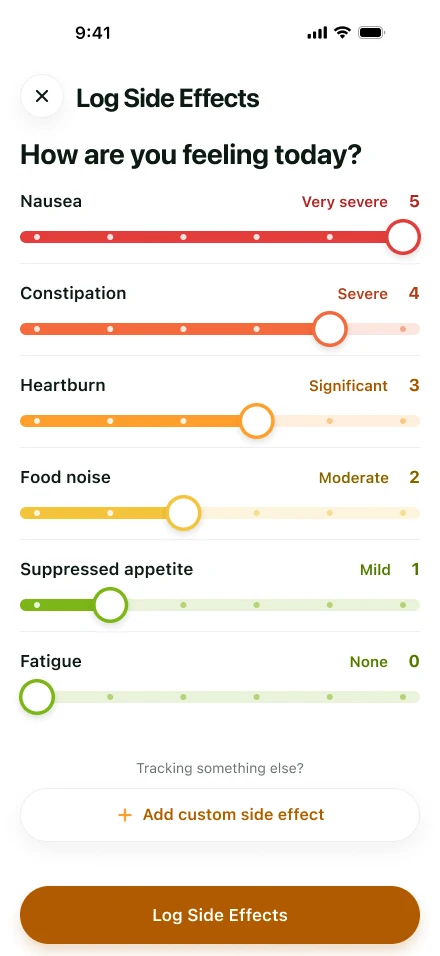
Side effects, by severity 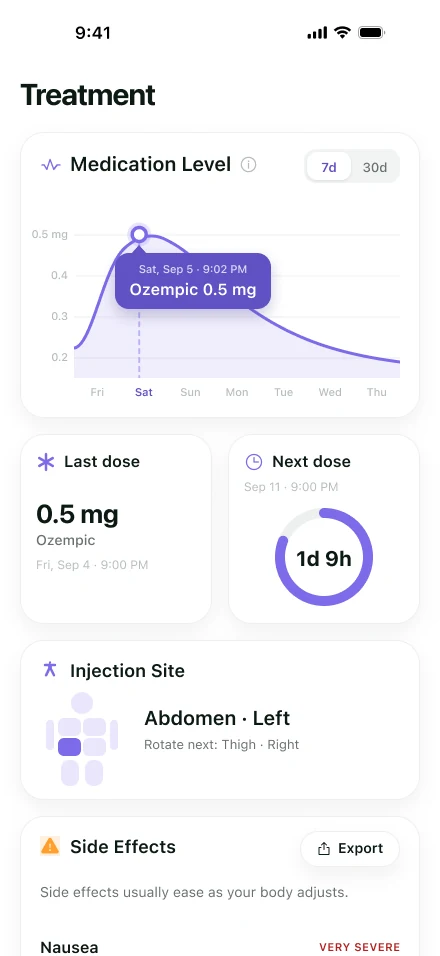
Medication level and next dose 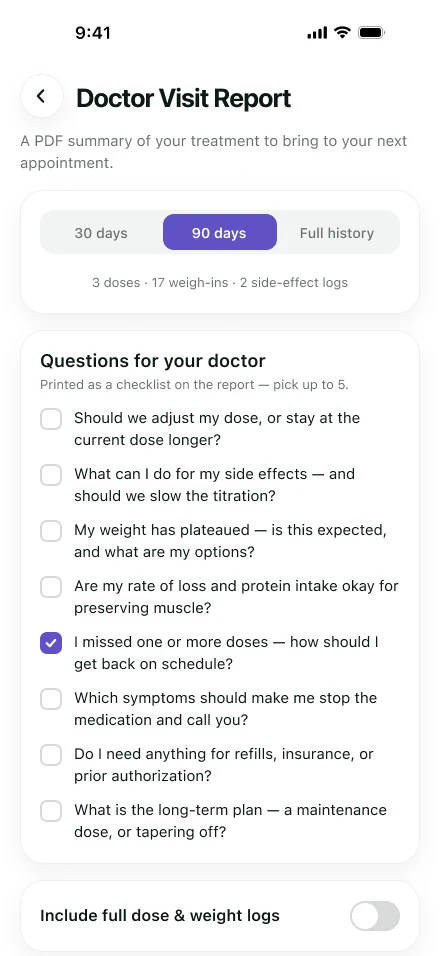
A report for your next appointment
Frequently asked questions
Does Zepbound cause hair loss?
The Zepbound label lists hair loss among its common side effects — 4–5% across doses in the main weight trials, against 1% on placebo — and says it was associated with weight reduction. It was far more common in women (7.1%) than men (0.5%), and no one on Zepbound stopped treatment because of it.
Does Ozempic cause hair loss?
The Ozempic label lists alopecia (hair loss) among reactions reported after approval, where a frequency can't be reliably estimated. The Wegovy label, which uses the same ingredient at higher doses for weight management, reports hair loss in 3% of people on 2.4 mg versus 1% on placebo.
Will my hair grow back?
The American Academy of Dermatology describes excessive shedding after a stressor such as losing 20 pounds or more as usually temporary, with hair tending to regain its fullness within six to nine months once the body readjusts. The GLP-1 labels don't give a recovery timeline, so if shedding continues, see a doctor or dermatologist.
Should I stop my GLP-1 because of hair loss?
Don't stop or change your dose on your own. Talk to your prescriber; the AAD also notes that stopping a medicine suddenly can cause serious side effects of its own.
Sources
- WEGOVY (semaglutide) injection and tablets prescribing information and Medication Guide — DailyMed, U.S. National Library of Medicine
- ZEPBOUND (tirzepatide) prescribing information and Medication Guide — DailyMed, U.S. National Library of Medicine
- OZEMPIC (semaglutide) prescribing information — DailyMed, U.S. National Library of Medicine
- MOUNJARO (tirzepatide) prescribing information — DailyMed, U.S. National Library of Medicine
- Do you have hair loss or hair shedding? — American Academy of Dermatology
- Nutritional priorities to support GLP-1 therapy for obesity: a joint Advisory from the American College of Lifestyle Medicine, the American Society for Nutrition, the Obesity Medicine Association, and The Obesity Society — Obesity (Silver Spring), 2025
Keep reading
 Side effects
GLP-1 Nausea — How Long It Lasts and What Helps
Nausea on Ozempic, Wegovy, Mounjaro or Zepbound? How common the labels say it is, when it tends to show up, what nutrition guidance suggests, and when to call.
- Side effects
GLP-1 Constipation — Why It Happens and What Helps
Constipation is one of the most common GLP-1 side effects. What the labels report, the gentle fixes nutrition guidance suggests, and when to call your doctor.
 Nutrition
Eating Out on Ozempic or Zepbound — How to Order and Enjoy It
Eating out on a GLP-1 with a smaller appetite? How to order protein-first, handle big portions and rich food, box leftovers, and log the meal without fuss.